

Leader of the Opposition in Parliament Joel Ssenyonyi has raised fresh concern over the sharp depreciation of the Uganda shilling, warning that the weakening currency is likely to increase pressure on households, businesses and the wider economy.
Ssenyonyi raised the concern during plenary as the shilling crossed the psychologically important Shs4,000 mark against the US dollar, reaching its weakest level on record.
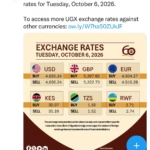
Commercial banks on Monday quoted the dollar at about Shs4,017 buying and Shs4,027 selling, marking the first time the shilling has sustained trading above the Shs4,000 level on bank boards.
The latest decline has been linked to increased demand for dollars from manufacturers, energy importers and traders preparing for end-of-year imports, as well as pressure from elevated global oil prices.
The latest developments have also brought renewed attention to a warning issued by Bank of Uganda Governor Michael Atingi-Ego in April when Parliament was scrutinising the Protection of Sovereignty Bill, 2026.
Appearing before the joint committees on Legal and Parliamentary Affairs and Defence and Internal Affairs on April 28, Atingi-Ego warned that the Bill, in its original form, could restrict cross-border financial flows and put pressure on Uganda’s foreign-exchange reserves and the shilling.
The Governor argued that Uganda’s economy depends on foreign financial inflows, including foreign investment, remittances and portfolio investment, to help finance the country’s trade deficit.
He warned that if such inflows were significantly reduced, Uganda could face greater pressure on its balance of payments, resulting in further depreciation of the shilling and increased inflationary pressure.
At the time, Atingi-Ego said Uganda’s foreign reserves were close to US$6 billion, while workers’ remittances had contributed about US$1.5 billion. He also pointed to foreign investors’ holdings of Ugandan government securities as an important source of foreign exchange.
The Bank of Uganda further raised concerns about provisions that could introduce additional approval requirements for foreign funding, warning that such restrictions could discourage investors and affect the country’s financial system.
Following the concerns raised by the central bank and other stakeholders, Parliament subsequently amended the proposed legislation.
The original version was significantly scaled back, including changes to provisions affecting Ugandans receiving foreign funds. Parliament eventually passed the revised legislation in May, and President Yoweri Museveni signed it into law on May 18, 2026.
However, the April warning remains relevant to the current currency debate because the Governor had specifically highlighted the connection between foreign-exchange inflows, reserves and the stability of the shilling.
The weakening currency is now being felt alongside high fuel prices.
Petrol at some major stations has risen to about Shs6,899 per litre, while diesel has been selling at around Shs6,699, bringing petrol close to the Shs7,000 mark.
The Ministry of Finance has also reported that average petrol and diesel prices in August stood at Shs6,529 and Shs6,647 per litre respectively, substantially higher than the levels recorded a year earlier.
A weaker shilling can compound the pressure because Uganda imports petroleum products and other essential goods whose international prices are largely denominated in US dollars.
Higher fuel costs can in turn increase transport, production and distribution expenses, eventually affecting the prices of food and other consumer goods.
Uganda’s annual inflation rose to 4.6 percent in September 2026, up from 4.1 percent in August, according to the Uganda Bureau of Statistics.
Against this background, Ssenyonyi is pressing the government to address the economic pressures facing Ugandans as the cost of fuel, transportation and imported goods continues to rise.
The current currency movement also places renewed focus on the government’s broader economic strategy, particularly efforts to increase exports, attract investment and reduce dependence on imports.
For households earning primarily in shillings, a weaker currency can reduce purchasing power as imported goods and services become more expensive.
For businesses, particularly those dependent on imported fuel, machinery, raw materials or merchandise, the depreciation can increase operating costs and force difficult decisions over whether to absorb higher costs or pass them on to consumers.
The debate over the shilling therefore goes beyond the exchange-rate figure displayed by commercial banks. It increasingly touches on fuel prices, inflation, household purchasing power, business costs and Uganda’s ability to generate enough foreign exchange to support its economy.
The Shs4,000-dollar threshold has now turned the currency debate into a much more immediate cost-of-living issue for Ugandans.