

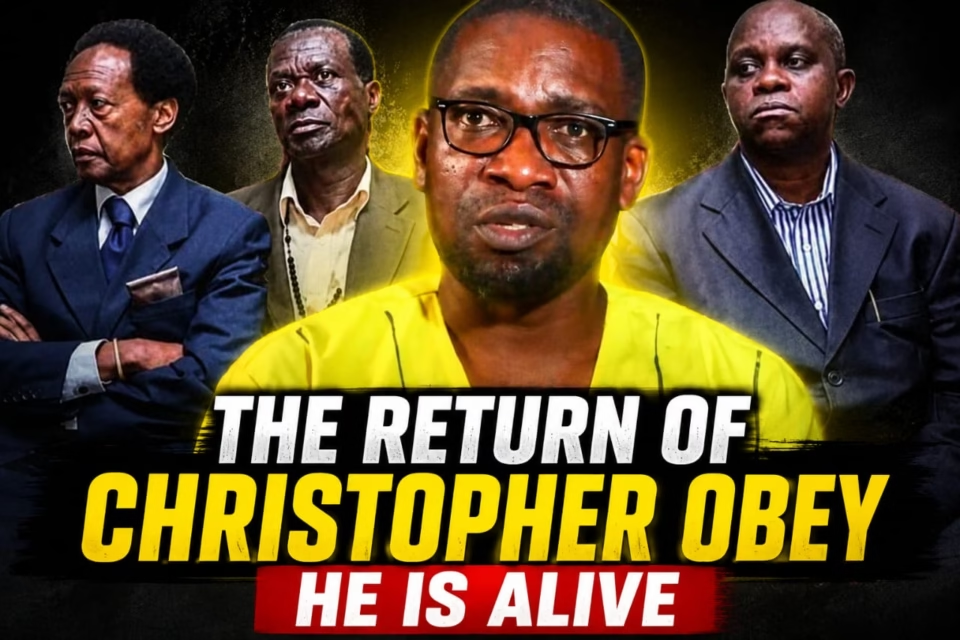
It has now been six years since former Ugandan civil servant and ex-Principal Accountant in the Ministry of Public Service Pension Department, Christopher Obey, remained a central and controversial figure in one of Uganda’s biggest public finance scandals involving the alleged embezzlement of over Shs165 billion.
He was implicated alongside former Permanent Secretary Jimmy Lwamafa and former Pensions Commissioner Stephen Kiwanuka Kunsa, accused of orchestrating a scheme involving the creation of ghost pensioners and the manipulation of government records.
Investigators further alleged that the group falsely budgeted about Shs88.2 billion as National Social Security Fund (NSSF) contributions, diverting large sums of public money.
Christopher also faced a separate conviction linked to the alleged forgery of judicial documents used to siphon approximately Shs15.4 billion, in collaboration with lawyer Bob Kasango.
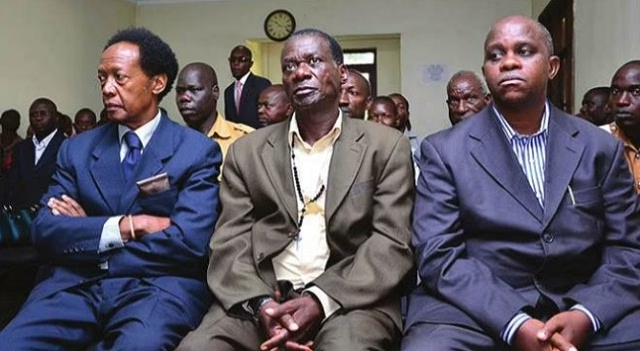
Following trial proceedings, Justice Lawrence Gidudu sentenced him to 10 years in prison and also in2018 judge Marget Tibuya convicted him for the second time for 14 years , marking one of the most high-profile convictions in Uganda’s anti-corruption drive.
However, recent claims by veteran investigative journalist Dean Lubowa have reignited public debate. Lubowa claims that Obey’s prison record is surrounded by irregularities, including suggestions that he may have been secretly assisted by prison officials and possibly escaped after serving part of his sentence.
The confusion deepens further due to conflicting reports about his death. Some accounts claim that obey died in July 2021 from pneumonia, while official prison records reportedly indicate that he died of COVID-19. These contradictory reports have fueled speculation and uncertainty over his true fate.
At the time of his incarceration, Obey had reportedly spent five years time at Luzira Prison said Dean after he had spent an initial remand period of about eight months before being granted a bail. However, the combination of alleged escape claims and disputed death records has left major gaps in the public understanding of what ultimately happened to him.
Authorities have not issued a clear, unified confirmation resolving the conflicting narratives. If any of the allegations—whether escape, survival beyond reported death, or record manipulation—are substantiated, they would raise serious concerns about accountability, prison administration, and record integrity within Uganda’s correctional system.
The pension scandal itself remains one of Uganda’s most significant corruption cases, widely cited as a symbol of systemic weaknesses in public financial management and the long-standing fight against corruption in government institutions.



2 comments
what offence did obey do?
that took him to ;luzira?
deep into our you tube channel