

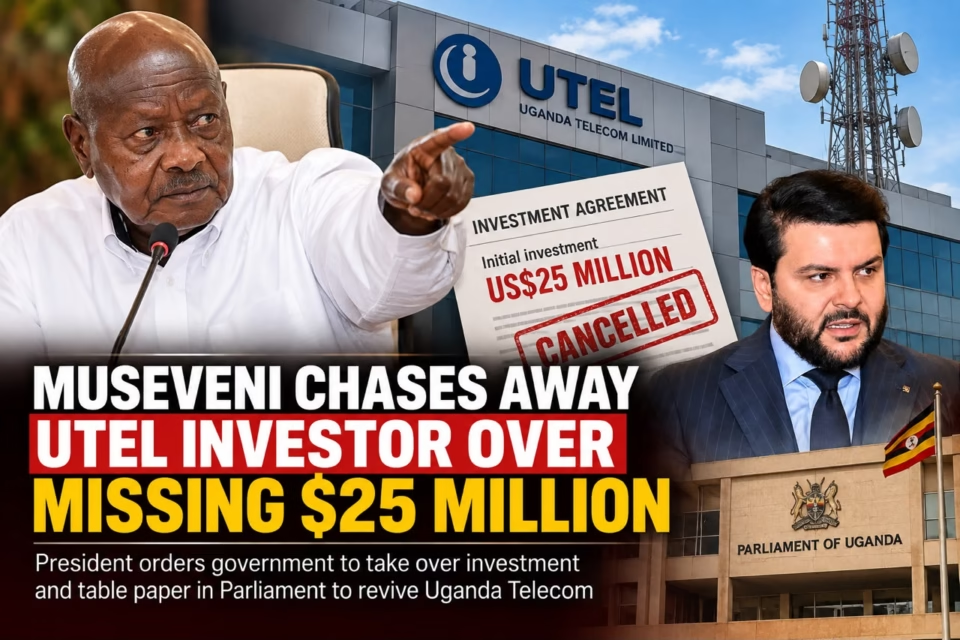
President Yoweri Museveni has reportedly ordered the cancellation of a $225 million investment agreement with Dubai-based Rowad Capital Commercial (RCC) to revive struggling state-owned telecommunications company Uganda Telecom Limited (UTel), following an alleged failure by the investor to meet its initial financial commitments.
According to reports, Museveni issued the directive during a State House meeting on October 6, 2026, instructing the Deputy Attorney General to begin the legal process of terminating the agreement.
The President also reportedly directed the relevant ministries to prepare a Cabinet paper proposing government funding to support UTel’s revival, raising the possibility that taxpayers could bear the cost of rescuing the struggling telecommunications operator if the private investment deal collapses.
Under the proposed agreement, RCC was expected to invest $225 million in UTel in exchange for a 60 per cent stake in the company, while the government would retain the remaining 40 per cent.
The investment was structured in phases, with RCC expected to make an initial payment of $25 million before investing a further $200 million over three years.
However, the reported failure to deliver the initial $25 million has raised concerns about the agreement’s implementation and the investor’s ability to fulfil its obligations.
Museveni reportedly questioned why RCC sought control of UTel’s assets, including Uganda’s national fibre-optic network, without first meeting its financial commitments.
The proposed cancellation would mark a major setback for efforts to attract private capital into UTel, which has faced longstanding financial and operational challenges.
The reported directive to prepare a Cabinet paper on government funding suggests that the government is considering alternative options for reviving the telecommunications company should the agreement with RCC be terminated.
Such a move could place additional pressure on public finances, particularly if the government has to provide substantial funding to restore the company’s operations and competitiveness.
It also raises questions about the government’s strategy for managing state-owned enterprises, attracting credible investors and ensuring that investment agreements deliver the promised financial benefits.
UTel’s future remains important to Uganda’s telecommunications sector, particularly because of its infrastructure and the government’s interest in maintaining a stake in strategic national assets.
However, any decision to cancel the RCC agreement would require the government to follow the applicable legal procedures and establish the consequences of terminating the contract.
As of the information contained in the report, the formal cancellation process and the government’s final financing plan had not been independently confirmed.