

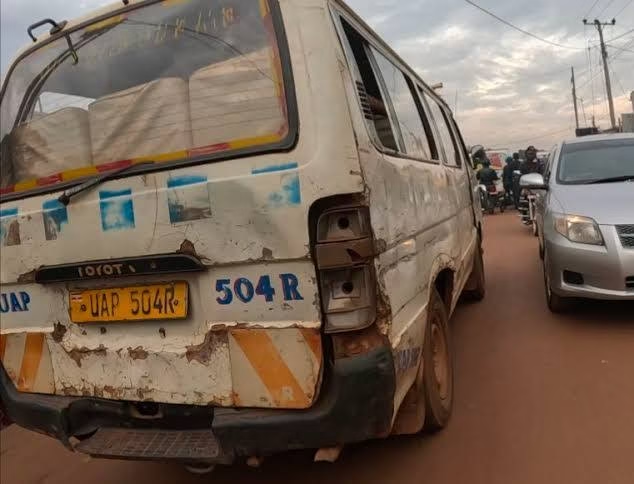
The Ministry of Works and Transport has launched a 100-day enforcement drive targeting commuter taxis operating in unsafe mechanical condition within the Kampala Metropolitan Area, in a renewed push to improve road safety.
Works and Transport Minister Fred Byamukama said the exercise will focus on the widely used 14-seater taxis that, despite their poor condition, continue to ferry passengers on busy routes.
He noted that earlier efforts to remove such vehicles from the roads had faced strong pushback from some operators, including threats of strikes and political retaliation, which slowed enforcement.
According to Byamukama, the government can no longer compromise on safety.
He described the condition of some of the taxis as alarming, saying many are barely fit for use.
“These taxis are in a terrible state. You find them still picking passengers, yet inside the seats are torn, dirty and in some cases unbearable. Some parts are literally held together with superglue. The conductor is using glue to keep the door shut, the doors don’t lock properly, and even the steering wheel is sometimes fixed with ropes,” he said.
The minister added that several of the vehicles operate with severely worn tyres and other mechanical faults that put passengers at constant risk.
He pointed out specific routes where such taxis are commonly seen, including Katooke Road in Nansana, Gganda–Kyebando, Kalerwe–Gayaza, Nakawa–Luzira, Kakiri and Busunju. He said many of these vehicles rarely reach the city centre, yet continue to operate full passenger loads.
Byamukama also warned against makeshift repairs such as tying vehicle boots with ropes, saying such practices make the vehicles even more dangerous on the road.
Beyond mechanical safety concerns, the government says some of the poorly maintained taxis have been associated with criminal incidents, including highway robberies. Officials also noted that some vehicles abandoned in garages are later refurbished and sold off to unsuspecting operators without proper safety checks.
The minister stressed that the taxi industry must take responsibility for improving standards, saying enforcement alone cannot solve the problem without cooperation from operators.
He further announced that starting Monday, police will begin impounding taxis found in dangerous mechanical condition. The Kampala Capital City Authority (KCCA) has allocated space in Nakawa where such vehicles will be held.
He warned that owners of vehicles deemed unfit for road use will not be allowed to reclaim them.
“Do not come asking for these vehicles back. If a car is dangerous to the public, it will not be released. We have tried engagement before, but there have been threats of strikes and political pressure. This time there will be no negotiation when lives are at stake,” Byamukama said.
The 100-day enforcement campaign will begin in Greater Kampala, where authorities say the problem is most widespread, before being expanded to other regions of the country.
The move has received mixed reactions from within the taxi industry. Muzamir Ndibo, Chairperson of Bwaise Taxi Park, welcomed the crackdown but questioned why the problem appears more concentrated in Kampala than in upcountry towns.
However, Ndibo also raised concerns about corruption within enforcement agencies, alleging that some traffic officers allow unroadworthy taxis back on the road after receiving bribes.
He claimed that in some cases, vehicles with obvious defects such as worn-out tyres and missing indicators are released after drivers pay off officers during roadside checks.
The crackdown is part of a broader national road safety campaign by the Ministry of Works and Transport and the traffic police. The ongoing measures include impounding vehicles without valid inspection certificates, addressing overloading, curbing reckless driving, and conducting random mechanical inspections at taxi parks and major highway checkpoints.