
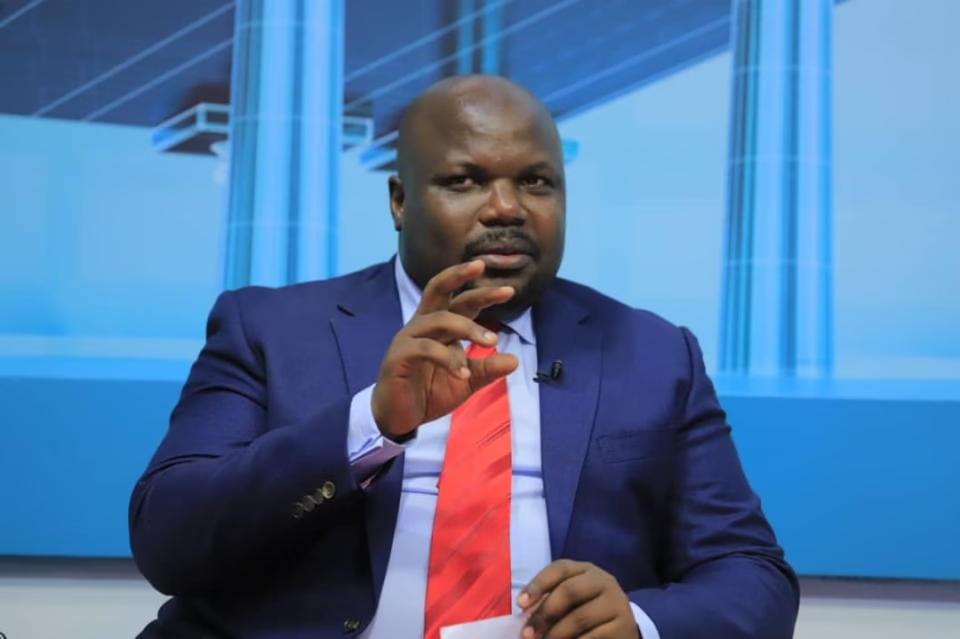
Common Man’s Party (CMP) president and former presidential candidate Mubarak Munyagwa has said Uganda’s biggest political challenge is President Yoweri Museveni, arguing that lasting peace and stability will only come if the President accepts and oversees a smooth transition of power.
Speaking during an interview at Tv10 gano mazima, Munyagwa said the country cannot achieve meaningful political stability while the question of succession remains unresolved. He argued that Museveni, as the country’s long-serving leader, has a major responsibility to ensure that power can be handed over peacefully.
According to Munyagwa, a transition managed without violence or political confrontation would give Ugandans greater confidence in the country’s future and help prevent the kind of political uncertainty that often accompanies changes in leadership.
Munyagwa, who contested the presidency on the Common Man’s Party ticket, has previously positioned his party as an alternative political force ahead of Uganda’s 2026 elections.
Munyagwa also took aim at National Unity Platform leader Robert Kyagulanyi Ssentamu, popularly known as Bobi Wine, questioning the effectiveness of his activities in the United States.
He argued that Kyagulanyi’s efforts abroad amount to a waste of time if they are mainly focused on highlighting alleged violations of his rights while, at the same time, he is able to travel through Uganda’s Entebbe International Airport.
Munyagwa used this to question what he described as contradictions in the opposition’s position on the political environment in Uganda.
He also pointed to the recent use of Kololo Airstrip for major public events, including musician King Saha’s concert, as another example of what he sees as a contradiction. King Saha held his “Tondeka e Kololo” concert at the airstrip on August 14, 2026 yet its a presidental parking area and only way to acess it is through acquiring permission through the ministry of defense.
Munyagwa questioned how opposition figures can portray Uganda as a place where certain rights and freedoms are completely unavailable while prominent figures associated with the opposition are able to organise large events at high-security locations such as Kololo.
His argument is that the issue should not simply be about making accusations from outside the country, but about examining the realities on the ground and finding practical ways of addressing Uganda’s political challenges.
Munyagwa’s remarks come at a time when Uganda’s political debate remains heavily focused on the question of leadership transition and the future of the country under Museveni.
For him, however, the solution lies less in confrontation and more in ensuring that the eventual transfer of power is peaceful, orderly and accepted by all sides.
He believes Museveni remains central to that process and that the President has an opportunity to shape a transition that could leave the country more politically stable.
The comments are likely to generate debate within the opposition, particularly among supporters of Kyagulanyi, who have consistently raised concerns about Uganda’s political environment and the treatment of opposition actors.
At the centre of Munyagwa’s message is a simple argument: Uganda needs a peaceful political transition, and he believes Museveni must be the one to make that transition possible.