
Long before Uganda’s music industry became a multimillion-shilling business, before local artists filled stadiums and DJs became celebrities, there was a small creative space in Rubaga that quietly helped shape the country’s entertainment revolution.
It was called Dungeon Studios.
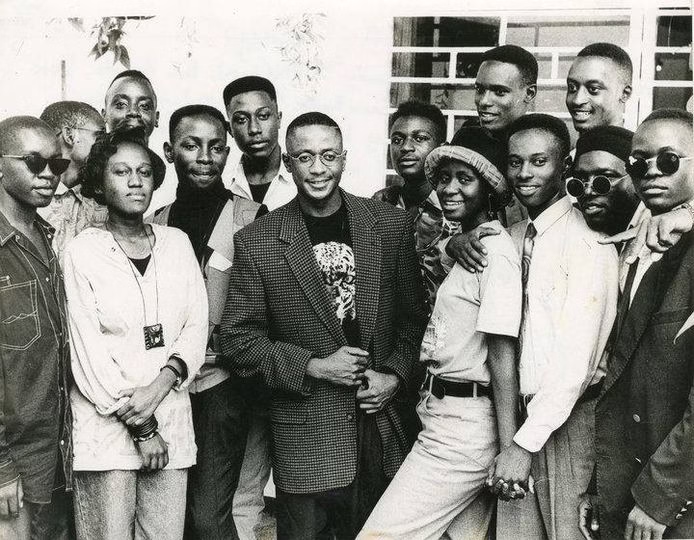
For many Ugandans, Dungeon may now sound like a name from a distant past. But in the 1990s, the studio was a meeting point for musicians, DJs, radio presenters, producers and performers who would go on to become some of the most recognisable figures in Uganda’s entertainment industry.
The story of Dungeon is closely linked to media entrepreneur Peter Ssematimba, who returned from the United States in 1994 with ambitions to transform Uganda’s broadcasting and entertainment landscape.
Dungeon became part of that vision, providing a platform where young creatives could experiment with new sounds and develop their talents.
At a time when reggae, ragga, rap, R&B and other international genres were gaining popularity among young Ugandans, Dungeon became a space where those influences could be given a distinctly local identity.
Among the most prominent names associated with the Dungeon generation was Ragga Dee, born Daniel Kazibwe.
He experimented with reggae, ragga and hip-hop while incorporating local influences, helping to define the sound of Uganda’s emerging urban music scene.
Songs including “Bamusakata,” “Ndigida” and “Oyagala Cash” established him as one of the important voices of the early contemporary music movement.
His career later extended beyond music into politics and cultural leadership, including his role as chairman of the National Culture Forum.
Dungeon was also home to one of Uganda’s pioneering female rap acts, Prim N’ Propa, made up of Brenda Z’Obbo and Lillian Butele Kelle.
Managed by Ssematimba, the duo emerged at a time when Uganda’s music industry was largely dominated by men.
Their song “Why” demonstrated that female artists could compete for space in Uganda’s growing rap and contemporary music scene.
Although both women later left Uganda, their contribution remains part of the early history of female participation in the country’s urban music industry.
Dungeon’s influence extended well beyond recording music.
The late Bob Bashabe, associated with the pioneering R&B and rap group Perfect Generation, later became the original host of Capital FM’s popular late-night programme “Late Date.” His voice became familiar to a generation of radio listeners before his death in the early 2000s.
Steve Jean Sserunkuma also began as a vocalist and producer before becoming one of Uganda’s influential music producers. His later establishment of Fenon Records and Fenon Events marked another stage in the professionalisation of Uganda’s entertainment industry.
Then there was Roger Mugisha, known to many radio listeners as “The Shadow.” His career stretched from radio to acting, MC work and brand consultancy, reflecting the versatility of the generation that emerged around Dungeon.
Simon Base Kalema followed a similar path. After gaining recognition as a singer, he moved into theatre, acting, screenwriting and film direction, working with groups including The Ebonies and Fun Factory.
A generation that kept reinventing itself
Jenkins Mukasa also started as a singer at Dungeon before moving into media and entertainment analysis.
Meanwhile, Terry Divos Atwooki attracted attention with his mid-1990s song “Owundikwenda”, although his musical career later took him outside Uganda.
The era also produced early hip-hop voices such as MC Afrique, born Jimmy Bageire, whose song “Watoto w’Africa” reflected attempts to give Uganda’s emerging rap culture an African identity.
Music was only one part of the Dungeon story.
Rasta Rob, born Robert Ogwal, became one of Uganda’s early celebrity DJs, working with platforms including Sanyu FM and CBS FM.
For a generation raised on cassette tapes, vinyl records, radio and nightlife, DJs were more than entertainers. They were cultural gatekeepers who helped determine which sounds reached young audiences.
Another important figure was Shanks ViviD, born Robert Baguma Baijukya, who emerged as an early figure in Uganda’s dancehall movement.
His influence extended to mentoring younger talent, including a young Jose Chameleone, who would later become one of Uganda’s biggest musical exports.
What made Dungeon Studios important was not simply the music produced there.
Its real power was the network of people and ideas it brought together.
Musicians met DJs. DJs interacted with radio presenters. Producers discovered singers. Actors crossed paths with musicians.
For young Ugandans, entertainment was increasingly becoming something more than a hobby. It was beginning to look like a profession.
The 1990s were a period of major cultural change. Commercial radio was expanding, Kampala’s nightlife was evolving and young people were increasingly exposed to international music and entertainment.
Dungeon became part of that transformation, providing a space where global influences could be mixed with Ugandan creativity.
Three decades later, Uganda’s entertainment industry bears little resemblance to the one these pioneers entered.
Artists now record in sophisticated studios, distribute music digitally, perform internationally and reach audiences through platforms such as YouTube, TikTok, Spotify and Instagram.
But the journey did not begin there.
The pioneers of the Dungeon era had radio, cassettes, nightclubs and small studios. What they lacked in technology, they made up for with experimentation, ambition and an audience eager for something new.
From Ragga Dee and Prim N’ Propa to Steve Jean, Roger Mugisha, Shanks ViviD and the many musicians, DJs, presenters and producers of their generation, Dungeon Studios became a symbol of Uganda’s first major urban entertainment revolution.
Perhaps the pioneers themselves did not realise the significance of what they were creating.
They were simply making music, entertaining audiences and pursuing careers.
But in doing so, they helped lay the groundwork for the industry that exists today.
Dungeon Studios was more than a studio. It was a launchpad — one of the places where modern Ugandan pop culture found its voice.