
For nearly four decades, Uganda’s political debate has largely revolved around one question: Who should govern the country?
But there is another question that may be even more important: How should political power be acquired, exercised, challenged and eventually transferred without pushing the country into confrontation?
Uganda’s political history suggests that this question remains unresolved.
The problem is not political disagreement itself. Disagreement is a normal part of democracy. The deeper challenge is whether the country has built strong enough institutions and political agreements to ensure that disagreement remains peaceful and manageable.
Since the National Resistance Army (NRA) came to power in January 1986, Uganda has experienced significant periods of stability and political change. Yet questions surrounding political competition, electoral credibility, the role of security institutions, opposition politics and peaceful political transition continue to generate debate.
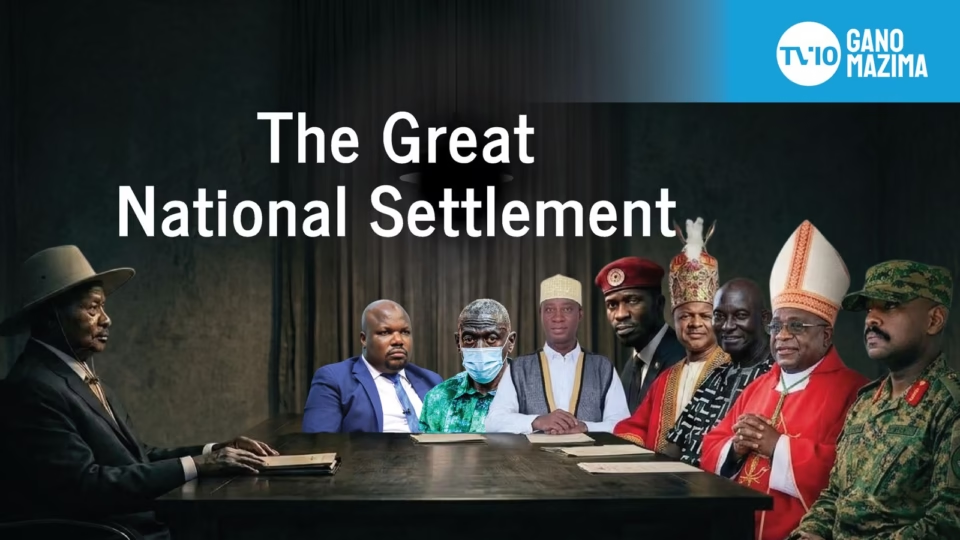
This raises the possibility of what could be described as a Great National Settlement — not a secret agreement among political elites, but a broad national conversation on the rules that should govern political competition.
When the NRA took power in 1986, Uganda was emerging from years of political instability, military coups, disputed elections and armed conflict.
The new government presented itself as a departure from the politics that had produced that instability. Stability, reconstruction and national unity became central themes.
The broad-based government also brought together politicians from different political backgrounds. Democratic Party leader Paul Kawanga Ssemogerere, for example, served as Minister of Internal Affairs.
That arrangement appeared to offer a bridge between the new government and Uganda’s older political establishment.
But it also raised a question that has remained relevant for decades: Was political inclusion intended as a long-term arrangement, or was it a transitional mechanism as the new government consolidated power?
The answer to that question continues to shape Uganda’s political debate.
Ssemogerere’s political journey illustrates the complexity of Uganda’s post-1986 politics.
After serving in government, he eventually returned to electoral competition and contested against President Yoweri Museveni in the 1996 presidential election as the candidate of the Inter-Political Forces Coalition.
His experience demonstrated that political accommodation does not necessarily eliminate political disagreement.
People can serve in the same government and later find themselves on opposite sides of the political divide.
That distinction remains important.
A country can remain united while its citizens disagree strongly over who should govern it and what direction government should take.
Another important turning point came from within the National Resistance Movement itself.
In 1999, Dr Kizza Besigye, a former bush-war combatant and senior figure in the Movement, publicly criticised the direction of the government. His concerns included corruption, abuse of power and the political direction of the NRM.
The disagreement eventually resulted in a major political break.
Besigye later returned to Uganda and contested the presidency, before becoming a leading figure in the opposition and founding president of the Forum for Democratic Change.
His political journey illustrates a recurring feature of Uganda’s politics: when disagreements cannot be resolved within a political system, they can eventually develop into organised opposition outside that system.
That pattern makes the question of how political disagreements are managed particularly important.
In July 2005, Ugandans voted in a referendum to return to a multiparty political system. The Electoral Commission records that the referendum adopted multiparty governance, followed by the 2005/2006 general elections.
The return to multiparty politics created a constitutional framework for competing political organisations to operate openly.
But elections alone could not resolve every political tension.
New questions emerged.
Could opposition parties compete on equal institutional ground?
Could the ruling party tolerate strong political opposition without interpreting it as a threat to national stability?
Could opposition parties themselves overcome divisions over leadership, alliances and strategy?
And perhaps most importantly, could Uganda build a political culture in which losing an election does not mean losing one’s place in the national political system?
These questions remain central to the country’s political conversation.
Uganda’s political difficulties cannot be attributed entirely to the ruling establishment.
Opposition parties have also faced serious internal disagreements.
The Democratic Party, Uganda People’s Congress, FDC and newer political formations have experienced disputes over leadership, candidate selection, alliances, ideology and political strategy.
The emergence of Robert Kyagulanyi Ssentamu, popularly known as Bobi Wine, and the National Unity Platform added another major force to Uganda’s opposition politics.
In the 2021 presidential election, the Electoral Commission’s final results gave Museveni 58.38 percent of valid votes and Kyagulanyi 35.08 percent.
Whatever political interpretation is placed on those figures, they show that Uganda’s electoral contest includes substantial support for competing political forces.
The question, therefore, is not simply whether opposition exists. It is whether Uganda’s political institutions can accommodate sustained competition without political disagreements escalating into wider crises.
Uganda’s recent electoral history has also kept questions about political freedoms, electoral administration, security operations and political space at the centre of national debate.
The important issue is not simply which political side is right or wrong.
The larger institutional question is what happens when citizens and political actors lose confidence in the institutions expected to manage political competition.
A political system depends not only on laws but also on trust in those laws and the institutions implementing them.
The Constitution itself provides a foundation for this discussion. Uganda’s constitutional objectives call for democratic participation, national unity, political diversity, tolerance and institutions capable of resolving conflicts fairly and peacefully.
Those principles provide a possible starting point for a broader national conversation.
Another unresolved issue concerns the relationship between security institutions and political life.
Uganda’s history makes this particularly sensitive.
The country has experienced political transitions involving military intervention, including the 1971 and 1985 coups and the NRA’s takeover in 1986.
For that reason, the relationship between the military, police, political parties, the presidency and constitutional institutions cannot simply be treated as an ordinary political disagreement.
It is also a question of national stability.
A Great National Settlement would therefore need to consider how security institutions can perform their constitutional responsibilities while maintaining a clear institutional distinction between national security and partisan political activity.
A Great National Settlement should not simply mean creating another government of national unity in which political leaders share government positions.
The idea would have to be broader.
It would mean developing a national framework for addressing some of Uganda’s longest-running political questions.
1. Electoral reform
Political parties, the Electoral Commission, civil society, religious leaders, academics and other stakeholders could engage in a serious discussion about electoral administration.
The central question would be:
What reforms can increase confidence that elections are transparent, credible and capable of producing results that political actors can challenge through lawful processes?
2. Political space
Government and opposition should be able to compete strongly without political competition automatically becoming a security crisis.
Opposition should be allowed to operate within the law, while government retains its responsibility to protect public order.
The challenge is finding an institutional balance between political freedom and public order.
3. The role of security institutions
There should be a clear and publicly understood distinction between the responsibilities of security institutions and the activities of political parties.
The Constitution provides for political participation and democratic competition, while security institutions have separate responsibilities.
The distinction should therefore be institutional rather than dependent on individual personalities.
4. Peaceful political transition
One of Uganda’s most difficult long-term questions is how political transitions should occur.
A mature political system should be capable of accommodating the departure of a long-serving leader without treating succession as the collapse of the State.
Equally, a change of government should not be treated as the destruction of the Republic.
Leaders change. The Republic remains.
That principle could become an important part of Uganda’s political culture.
5. Internal democracy in political parties
Political parties also have responsibilities.
Opposition parties cannot demand democratic institutions nationally while struggling to resolve their own internal disputes over leadership, candidates and alliances.
The same principle applies to the ruling party.
Political organisations need effective mechanisms for managing internal disagreements before those disagreements become national political crises.
6. A different political culture
Uganda may also need to move away from the idea of politics as a permanent battle between enemies.
The NRM cannot simply wish the opposition away.
The opposition, equally, cannot wish away the NRM.
Both are part of Uganda’s political reality.
The challenge is creating a system in which they can compete, disagree and change governments without threatening the stability of the country.
Why the conversation matters now
Uganda has gone through several political generations.
The generation that experienced independence and the early post-independence crises is ageing.
The generation associated with the 1980s bush war is also moving towards the later stages of political leadership.
At the same time, a younger generation has entered politics with different expectations about democracy, technology, employment, accountability and participation.
These generations cannot continue communicating primarily through political confrontation.
There is a need for a national conversation capable of bringing their different experiences and expectations into one political framework.
Who should participate?
If Uganda were to pursue a Great National Settlement, the conversation would need to go beyond political parties.
It could involve:
- Government and the NRM;
- Opposition political parties;
- Independent politicians;
- Religious leaders;
- Cultural institutions;
- Civil society organisations;
- Academics and constitutional lawyers;
- Security-sector representatives;
- Business and labour organisations;
- Youth and women’s organisations; and
- Ordinary Ugandans.
The objective would not be to decide who deserves political power.
It would be to establish how political power should be obtained, exercised, challenged and transferred while protecting the rights and dignity of citizens.
Uganda’s political question is bigger than Museveni
For almost four decades, Uganda’s political debate has often centred on President Yoweri Museveni.
But the country’s institutional question is bigger than one individual.
The same institutions, political parties, constitutional arrangements and security structures will remain relevant beyond the current political generation.
Whoever eventually governs Uganda will inherit those institutions and the history of political mistrust surrounding them.
Changing the person at the top, therefore, would not necessarily resolve every underlying institutional question.
The bigger question is:
What kind of political settlement should govern Uganda beyond the current political generation?
The choice before Uganda
Uganda can continue addressing political disputes one crisis at a time — election after election, protest after protest, arrest after arrest and political alliance after political alliance.
Or the country can have a deeper conversation about the institutions and rules that repeatedly bring these disputes to the surface.
The return to multiparty politics in 2005 was an important constitutional development, but multiparty elections by themselves cannot guarantee political trust.
Trust requires institutions.
Institutions require rules.
And those rules need to be respected by both those in power and those seeking power.
Most importantly, political losers must retain confidence that they remain citizens with rights, dignity and a legitimate place in the Republic.
Conclusion: A settlement before another crisis
Uganda’s history has already demonstrated the cost of unresolved political disagreements.
From the political instability preceding 1986, through the broad-based government, Ssemogerere’s return to opposition, Besigye’s break with the NRM, the return to multiparty politics and the emergence of newer opposition movements, Uganda’s political story has repeatedly shown that disagreements do not simply disappear.
They accumulate.
When institutions fail to provide peaceful channels for resolving them, they can return in more difficult forms.
The answer does not have to be the elimination of disagreement or opposition.
Instead, Uganda could consider building a political settlement strong enough to accommodate disagreement while protecting constitutional order.
That is the idea behind a Great National Settlement: a national agreement on political competition, constitutionalism, electoral credibility, security-sector professionalism, peaceful transition and the rights of citizens regardless of their political affiliation.
For decades, Uganda has debated who should rule.
Perhaps the deeper question now is:
How should Uganda be governed when political power changes hands?
That is a question bigger than any individual politician or political party — and one that could shape the country’s next political chapter.