
Uganda’s death penalty has returned to the centre of national debate following a series of high-profile murder cases in which courts have imposed the maximum punishment.
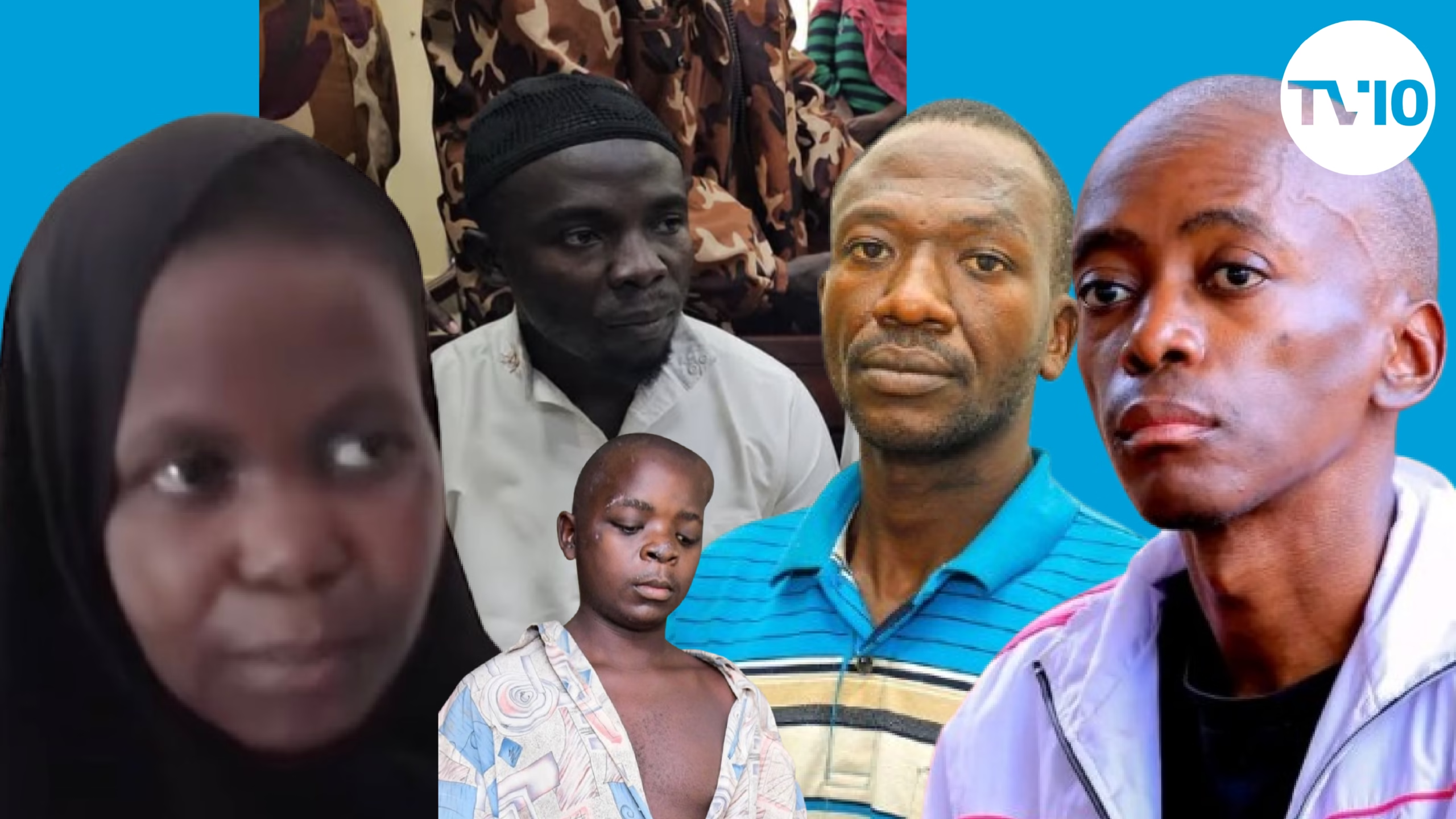
In 2026 alone, five convicts in three major cases have been sentenced to death: Christopher Okello Onyum, convicted over the killing of four toddlers at a Ggaba daycare centre; Hajara Nakandi and Abbas Musa Buvumbo, convicted in the kidnapping and murder of businesswoman Susan Magara; and Lujja Bbosa Tabula and Noah Lugya, alias Fake, convicted over the assassination of former Ndiga Clan leader Engineer Daniel Bbosa.
These cases are significant because Uganda retains the death penalty in law, but courts are required to exercise discretion rather than impose it automatically. The Supreme Court, in the landmark Susan Kigula case, ruled that mandatory death sentences were unconstitutional because they denied courts the opportunity to consider mitigating circumstances. The death penalty itself, however, was retained.
- Christopher Okello Onyum — Ggaba Daycare Murders
The first case involved Christopher Okello Onyum, who was sentenced to death on April 30, 2026, for murdering four toddlers at a daycare centre in Ggaba, Kampala.
The children — Gideon Eteku, Keisha Agenorwoth Otim, Ignatius Sseruyange and Ryan Odeke — were killed on April 2 after Onyum entered the daycare centre. The High Court found that the killings were exceptionally brutal and calculated.
Justice Alice Komuhangi Khaukha classified the crime among the “rarest of the rare” cases warranting the maximum punishment. The court also considered the vulnerability of the victims, the circumstances of the attack and what it described as a lack of remorse.
The trial itself attracted extraordinary public attention. Proceedings were conducted through a mobile court at Ggaba, close to where the children were killed. Eighteen prosecution witnesses testified during the proceedings.
Onyum’s defence raised questions about his mental state, but the judge rejected the insanity defence, finding that the medical evidence did not establish that he was legally insane when the murders were committed.
The case, however, is not yet legally final. Onyum appealed against both his conviction and sentence, arguing that the trial court improperly evaluated the evidence and rejected his mental-health defence. - Hajara Nakandi — Susan Magara Murder
The second death sentence went to Hajara Nakandi, one of nine people convicted over the 2018 kidnapping and murder of businesswoman Susan Magara.
The case dates back to February 7, 2018, when Magara was abducted in Kampala. Her kidnappers demanded an initial ransom of US$1 million. After negotiations, her family paid about US$200,000, equivalent to roughly Shs700 million at the time.
But the payment did not save her life.
According to evidence presented in court, Magara was held captive for weeks. Her kidnappers cut off two of her fingers and sent them to her family alongside a video intended to pressure them into paying the ransom.
Her body was later recovered after she had been killed. The court found that the crime had been carefully planned and executed for financial gain.
Justice Alex Mackay Ajiji found Nakandi to have played a central role in the captivity. The court heard that she guarded Magara and was involved in the circumstances surrounding the decision to kill her.
The judge concluded that Nakandi’s role, combined with the extreme brutality of the crime, justified the maximum sentence. - Abbas Musa Buvumbo — The Man Accused of Carrying Out the Brutal Acts
Abbas Musa Buvumbo was the second convict sentenced to death in the Magara case.
The court considered him one of the principal actors in the murder. Evidence before court showed that he personally participated in the most brutal aspects of Magara’s torture.
According to the prosecution case, Buvumbo cut off Magara’s fingers, injected her with ketamine and participated in suffocating and strangling her.
Justice Ajiji described the crime as calculated, premeditated and exceptionally cruel. He concluded that Buvumbo and Nakandi had played the most crucial roles among the nine accused.
The remaining seven convicts were sentenced to life imprisonment, reflecting the court’s distinction between their individual roles and those of the two people who received the death penalty.
The court also ordered the confiscation and sale of properties and vehicles allegedly acquired using the ransom proceeds, with the money to be used to compensate Magara’s family. All nine convicts have the right to appeal. - Lujja Bbosa Tabula — Engineer Daniel Bbosa Assassination
The fourth death sentence was handed down on August 13, 2026, when the High Court in Kampala sentenced Lujja Bbosa Tabula to death for his role in the assassination of Engineer Daniel Bbosa, former leader of the Ndiga Clan in Buganda.
The murder occurred on February 25, 2024, when armed attackers riding a motorcycle intercepted Engineer Bbosa as he returned home after presiding over a clan function in Katosi.
He was travelling with his wife and a domestic worker when the attackers opened fire.
Tabula and his co-convict, Noah Lugya, pleaded guilty to murder.
Prosecution evidence indicated that Tabula supplied the firearm used in the assassination and tracked Bbosa before the attack. Ballistic examinations reportedly linked the weapon to cartridges recovered from the crime scene.
The prosecution also presented the killing as a contract-style assassination linked to a long-running leadership dispute within the Ndiga Clan.
Justice David Matovu said the premeditated and brutal nature of the murder justified the maximum punishment. Although the two men were first offenders who showed remorse by pleading guilty, the judge found those mitigating circumstances outweighed by the seriousness and calculated nature of the crime. - Noah Lugya — Alias “Fake”
The fifth death sentence went to Noah Lugya, alias Fake, who was convicted alongside Tabula for the murder of Engineer Daniel Bbosa.
According to the prosecution case, Lugya was part of the group involved in planning and executing the assassination. The court heard that the plotters held clandestine meetings and considered different methods of killing their target before carrying out the shooting.
Lugya was reportedly rescued by security officers after being attacked by angry boda-boda riders following the assassination. Another alleged co-conspirator, Enock Sserunkuma alias Munaku, died after being beaten by a mob during the chase.
Justice Matovu warned that mob justice could have destroyed crucial evidence and emphasised that suspected criminals must face the courts rather than punishment by the public.
The court sentenced both Lugya and Tabula to death, while three other accused persons — Harriet Nakiguli, Joseph Nakabake and Ezra Mayanja — denied the allegations and are scheduled to stand trial separately.
What These Five Sentences Mean for Uganda
The five cases have revived an old question: Does Uganda still believe in the death penalty, or is it gradually moving towards abolition?
Legally, Uganda remains a country where capital punishment is permitted. The Judiciary has explained that the death penalty is no longer mandatory following the Susan Kigula decision, but judges can impose it in exceptional cases where aggravating circumstances justify the maximum punishment.
The Constitutional Court and later the Supreme Court also held that prolonged delay after a death sentence has been confirmed by the highest appellate court can amount to cruel, inhuman or degrading treatment. The Supreme Court specifically identified a period exceeding three years after confirmation as potentially unconstitutional.
Uganda has also gone for years without carrying out civilian executions. The Uganda Broadcasting Corporation reported in 2025 that President Museveni had not signed a death sentence since 1995, while contemporary reporting places the country’s last civilian executions under the current government in 1999.
This creates an important distinction: being sentenced to death does not mean a convict will necessarily be executed.
Each of the five convicts has a right to challenge the conviction or sentence through the appellate process. In Onyum’s case, an appeal has already been filed. The Magara convicts also have 14 days from sentencing to appeal, while the Bbosa case remains subject to the normal appellate process.
The Bigger Picture
Taken together, these five death sentences show a Ugandan judiciary willing to use the maximum punishment in cases it considers exceptionally brutal, calculated or socially devastating.
The Ggaba daycare killings involved the deaths of four extremely young children.
The Susan Magara case involved kidnapping, ransom, torture and murder despite the payment of the negotiated ransom.
The Daniel Bbosa case involved a premeditated assassination linked to a leadership dispute within a prominent Buganda clan.
In each case, the courts relied heavily on aggravating circumstances to justify moving beyond imprisonment and imposing the ultimate sentence.
But the final chapter remains unwritten. Appeals, presidential clemency, commutation and the constitutional safeguards surrounding executions mean that a death sentence is not necessarily the end of the legal journey.
For Uganda, these cases have therefore reopened not only the question of punishment for the most serious crimes, but also the much broader debate over whether capital punishment should remain on the statute books in a country that has largely moved away from actually carrying out executions