
By Sir Dean Lubowa Saava
TV10 Deep State Political Desk
Uganda’s succession question has entered a new and potentially decisive chapter. For years, the question of who will eventually replace President Yoweri Kaguta Museveni has been discussed as a political mystery, a family question, a military question and, increasingly, a question of generational transition.
But this week, an important piece of the puzzle moved. President Museveni presided over the retirement of a large group of senior Uganda Peoples’ Defence Forces officers, including some of the most recognisable commanders of the generation that fought, consolidated and defended the National Resistance Movement government.
The official explanation is straightforward: retirement is part of the normal military cycle. But in Uganda’s unusually intertwined political-military system, the timing, composition and scale of such a transition inevitably invite a bigger question: what does the changing face of the UPDF mean for the politics of succession?
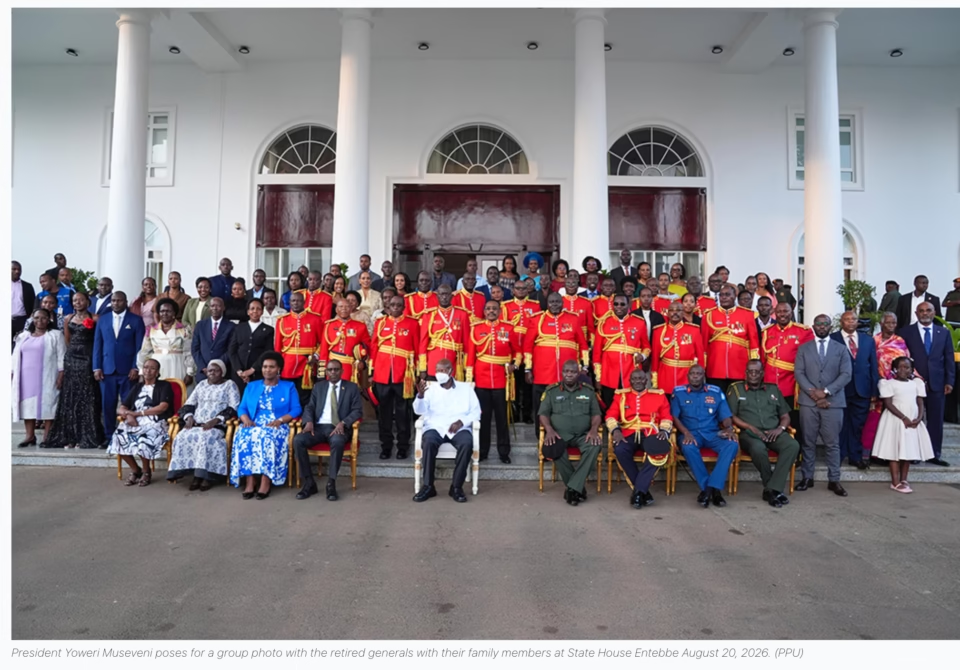
The retirement exercise formally concluded on August 20, 2026, with the UPDF saying 19 General Officers were being retired. The broader exercise involved 1,817 personnel, including generals, senior officers, junior officers and militants.
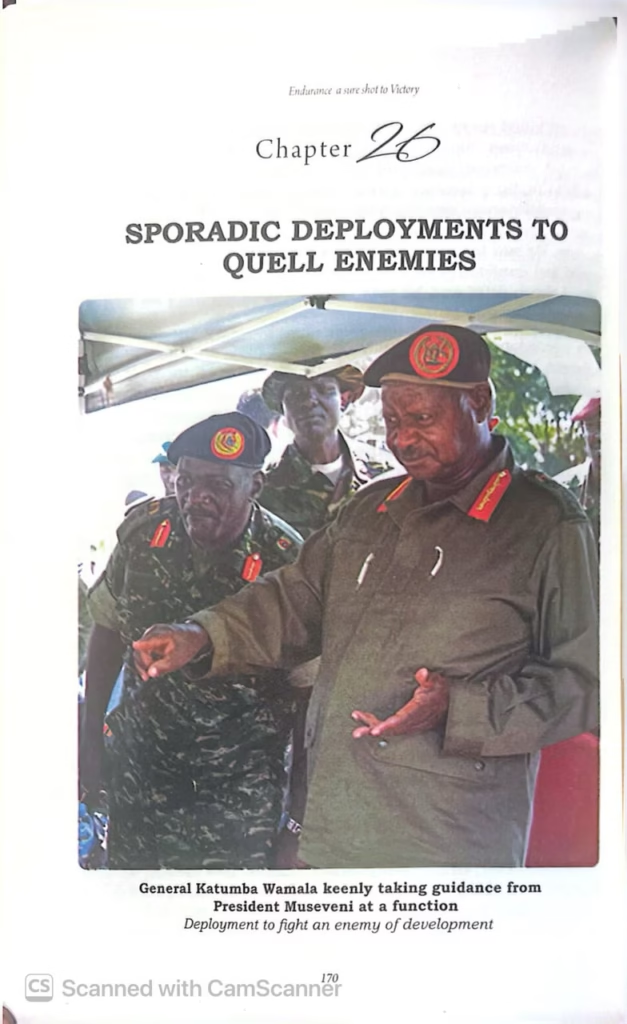
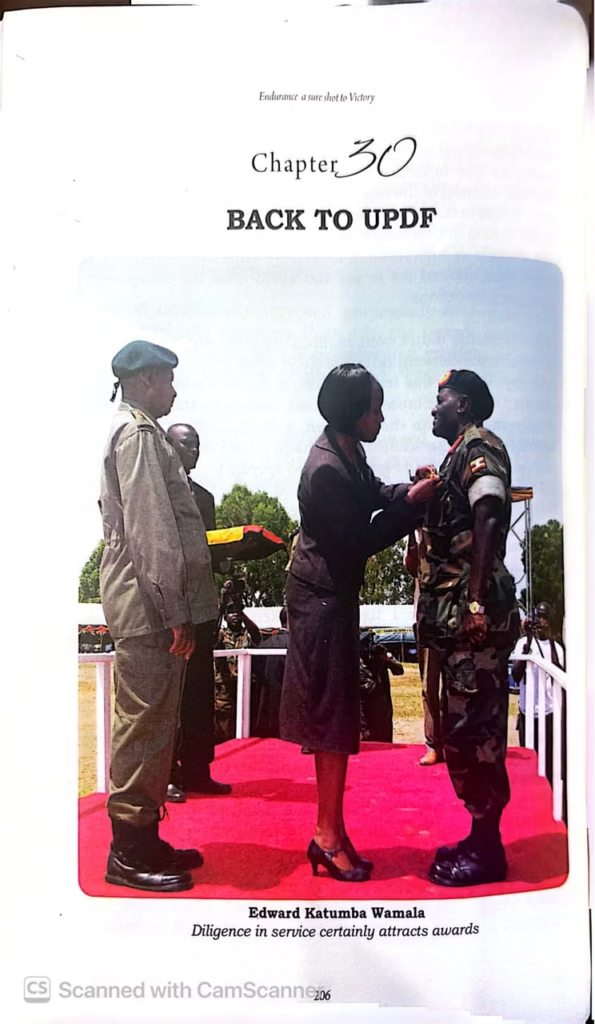
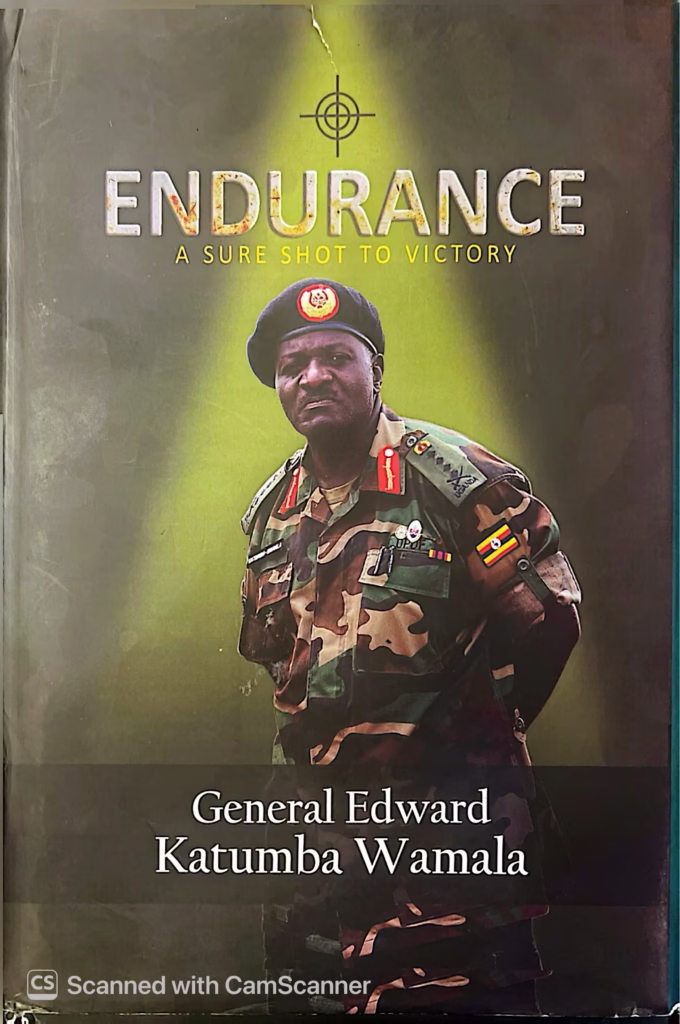
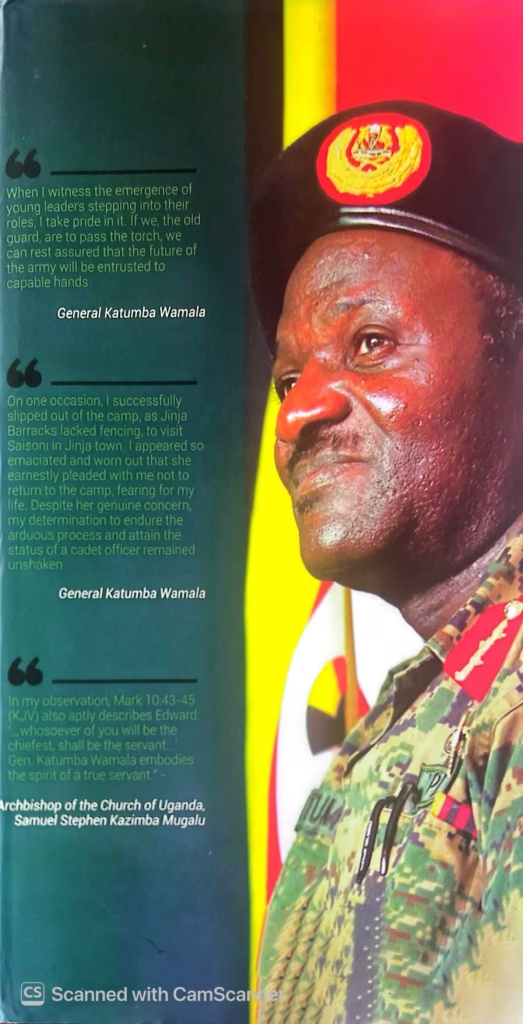
Among the senior figures leaving active military service are Gen Edward Katumba Wamala, Lt Gen Charles Otema Awany, Lt Gen Charles Angina, Maj Gen Abel Kandiho, Maj Gen Geofrey Katsigazi Tumusiime, Maj Gen Apollo Kasiita-Gowa and Maj Gen Leopold Eric Kyanda, alongside several brigadier generals.
The question for political observers is not whether these officers deserve retirement.
The question is what kind of military and political architecture is emerging after their departure.
THE OLD GUARD IS GETTING SMALLER
The generation now leaving active service is not an ordinary generation of soldiers. Many of these officers belong to the military establishment that emerged from the NRA bush war and the subsequent transformation of the NRA into the UPDF.
Their careers span some of Uganda’s most consequential political and security moments. Gen Katumba Wamala, for example, has spent decades moving between the military and senior government positions. His retirement from the UPDF comes after a reported 47 years of military service.
Others on the list have occupied influential command, intelligence, operational and administrative positions. Their departure therefore represents more than a personnel announcement.
It is a generational change inside the security establishment.
And that matters because in Uganda, the army has historically been more than an institution concerned exclusively with national defence. The military has been central to the political history of the country since 1986.
President Museveni himself came to power through an armed struggle and has repeatedly linked the present UPDF to the NRA’s historical mission. At retirement ceremonies, he has frequently reminded retiring officers of the army’s origins and ideological foundations.
So when the generation that built that institution begins disappearing from active command, Uganda inevitably enters a different political era.
THE SUCCESSION QUESTION
For nearly four decades, Uganda’s biggest political question has remained remarkably simple:
Who comes after Museveni?
The question has survived several generations of politicians. It has outlived the rise and fall of several political alliances. It has survived opposition movements, cabinet reshuffles, military promotions and retirements. But the question has become increasingly difficult to separate from the evolution of the UPDF.
One reason is obvious.
The current Chief of Defence Forces is Gen Muhoozi Kainerugaba, President Museveni’s son. The official UPDF leadership structure lists Muhoozi as CDF, with Lt Gen Samuel Okiding as Deputy CDF/Inspector General of Defence Forces and Lt Gen Kayanja Muhanga commanding the Land Forces.
That does not prove a predetermined presidential succession plan. But it does make every major military transition politically significant. And this is where the story becomes interesting.
THE MUHOOZI QUESTION
The possibility of Muhoozi Kainerugaba eventually seeking Uganda’s presidency has been debated for years. Importantly, Muhoozi himself has previously rejected the idea that Uganda is a monarchy in which power can simply be handed from father to son.
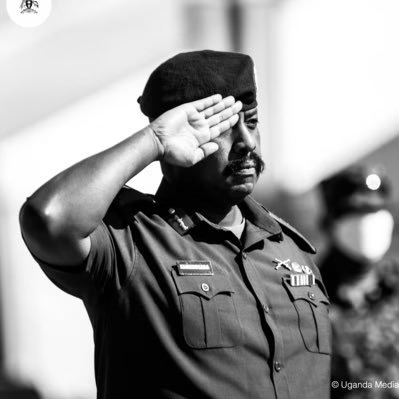
In an earlier statement reported by Daily Monitor, he said Uganda was not a monarchy and that Ugandans—not one individual—would determine who governs the country. He nevertheless acknowledged that, as a Ugandan, he could legally seek elective office.
That distinction remains important.
A military position does not automatically translate into a presidential succession. Uganda’s presidency is constitutionally elective.
Therefore, any theory that Muhoozi is simply being “installed” as president must remain an allegation unless supported by concrete evidence. But politics is not only about what is formally written.
It is also about institutions, networks, loyalties, timing and the people occupying strategic positions when political transitions occur. That is why the retirement of an older generation of generals deserves scrutiny.
IS MUSEVENI CLEARING THE BOARD?
This is where the TV10 Deep State question begins. Could the retirement of these generals be part of an intentional effort by President Museveni to create room for a younger generation of commanders?
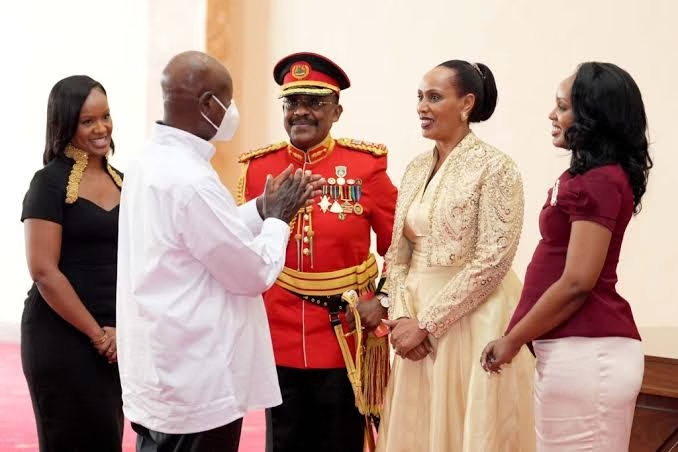
Possibly.
But there is no public evidence establishing that the 2026 retirement exercise was designed specifically to facilitate Muhoozi’s presidential ambitions.
There is, however, an undeniable institutional reality:
the composition of Uganda’s security leadership is changing. The military is moving from commanders associated with the early NRA/UPDF generation toward a younger leadership cohort.
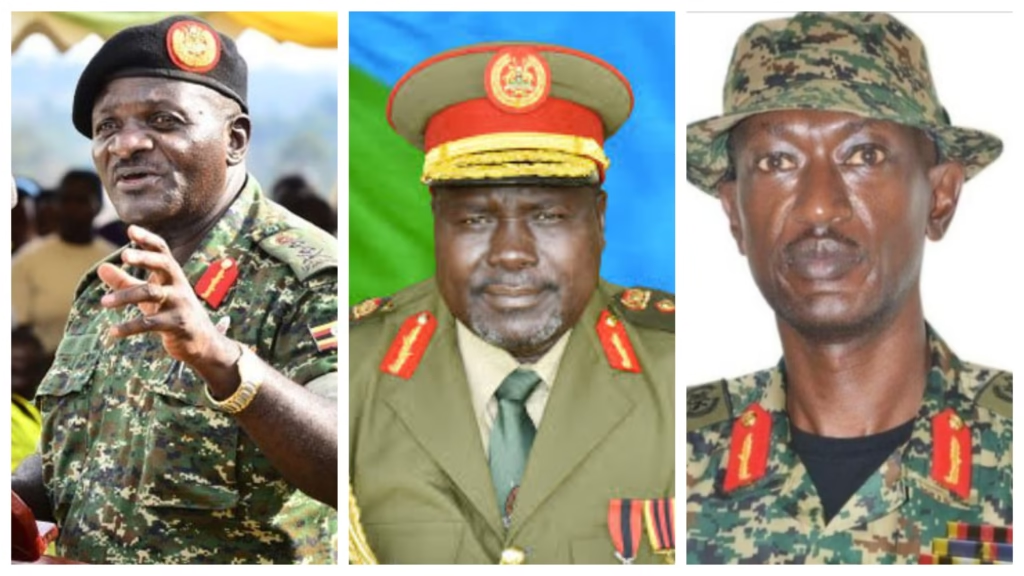
That transition would have happened eventually because armies have retirement rules, career structures and generational succession. But the political significance lies in who occupies the vacancies created by that transition.
THE NEW CENTRE OF GRAVITY
A fascinating feature of Uganda’s current military architecture is the emergence of officers from a younger generation into strategically important positions.
Muhoozi is now CDF.
Maj Gen David Mugisha is Commander of Special Forces Command. Lt Gen Kayanja Muhanga commands the Land Forces. Maj Gen Charles Okidi heads the Air Force. Maj Gen Jackson Bakasumba serves as Chief of Joint Staff.
These are not peripheral positions. They sit at the heart of the country’s military command structure.
The question therefore becomes:
What happens to Uganda’s political system when the generation surrounding Museveni increasingly gives way to a generation that has risen under a different command architecture? That is potentially more important than any individual retirement.
FROM WAR LORDS TO INSTITUTIONAL COMMANDERS
There is another way of looking at the current transition. The NRA generation was shaped by war. The younger generation was shaped largely by an established state.
That distinction matters.
The commanders who fought in the bush understood political survival through the lens of armed struggle, loyalty and revolutionary organisation.
The younger officers have grown within a professionalised military structure with international peacekeeping experience, specialised commands, advanced training and increasingly complex regional security responsibilities.
This creates a fundamental transition:
from a liberation army dominated by historical commanders to a modern military increasingly dominated by professional officers whose careers were built inside the system. That transition could eventually alter the relationship between the military and Uganda’s politics.
WHY THE TIMING MATTERS
The 2026 retirement exercise comes at a particularly sensitive political moment. Uganda is moving deeper into another succession cycle. President Museveni remains the central political figure of the NRM.
But every election cycle inevitably brings the succession question back to the table. The retirement of senior generals therefore creates a political vacuum that will be watched closely.
Not because retired generals automatically become political kingmakers. But because military institutions carry memory.
They carry relationships. They carry historical loyalties. They carry networks built over decades. And when an entire generation leaves active service, those networks inevitably change.
THE “MESSIAH” THEORY
In Uganda’s political mythology, every generation eventually begins looking for a “messiah”—the individual believed capable of taking the country into its next political era.
For some NRM supporters, that figure could emerge from within the movement. For others, it could come from outside the established political order. And for those following the Muhoozi succession debate, the First Son is increasingly viewed as one of the central figures around whom the post-Museveni conversation is likely to revolve. But there is a danger in treating succession as though it has already been decided.
It has not.
Uganda’s politics can change dramatically. A candidate can rise and disappear. An alliance can collapse. A military figure can retire. A civilian politician can unexpectedly become powerful. Public opinion can shift.
And elections can produce outcomes that political insiders did not anticipate. Therefore, the real story may not be that Museveni has already selected his successor. The deeper story may be that the system around the succession is gradually being prepared for a generational change.
WHAT HAPPENS TO THE OLD NETWORK?
This may be the most important question. When senior generals retire, do they simply disappear?
Not necessarily.
Retired officers can remain influential through government appointments, business, political relationships, veteran networks, advisory roles and personal connections. President Museveni himself has historically moved military officers into civilian positions.
The retirement of Gen Katumba Wamala is a striking example of the fluid boundary between military service and civilian government. His career has crossed both spheres.
Therefore, retirement from the UPDF does not necessarily mean retirement from Uganda’s national power structure. It may simply mean a change of platform.
THE REAL BATTLE MAY BE BELOW THE RADAR
If there is a succession struggle taking shape, it is unlikely to begin with politicians publicly announcing that they are fighting for power.
The early signs would be subtler.
Who controls the institutions?
Who controls the political networks?
Who controls access to the presidency?
Who commands the confidence of the security establishment?
Who can mobilize support within the NRM?
Who can attract young voters?
Who can maintain relations with regional actors?
And perhaps most importantly:
Who can inherit the political machinery that Museveni has built over four decades?
That is the real game.
MUSEVENI’S BIGGEST CHALLENGE
For President Museveni, succession is not merely about identifying an individual. It is about ensuring that the political system he created survives him. That is a much harder problem.
A successor who lacks legitimacy could destabilise the NRM. A successor who is too independent could dismantle the old power networks. A successor who is too weak could invite factional struggles.
And a successor who relies excessively on the military could create a different political crisis. This is why succession in Uganda cannot simply be reduced to the question:
“Is it Muhoozi?”
The bigger question is: “What happens to Museveni’s system when Museveni is no longer the person holding it together?”
THE DEEP STATE ANGLE
This is where the term “Deep State” requires caution. There is no publicly established evidence proving the existence of a secret body that has already decided Uganda’s next president.
But Uganda undeniably has powerful formal and informal networks around the presidency, security institutions, the NRM, business interests and state administration.
Those networks matter.
And the retirement of 19 senior generals, according to the official UPDF/UBC account, is one of the clearest visible signs that Uganda’s old security establishment is undergoing a generational transformation.
The invisible question is therefore not necessarily:
“Who has been secretly chosen?”
It is: “Who is being positioned to inherit influence?” That is a much more useful investigative question.
THE BATTLEFIELD WITHOUT BULLETS
Museveni came to power through a battlefield. His successor will almost certainly have to win a different battlefield.
The battlefield of elections.
The battlefield of public opinion.
The battlefield of NRM structures.
The battlefield of security confidence.
The battlefield of elite alliances.
And the battlefield of generational politics.
The generals retiring today helped create the political order that has governed Uganda since 1986.
The officers rising tomorrow will inherit that order. The question is whether they will merely defend it — or eventually help redesign it.
THE BIG QUESTION FOR TV10
Uganda may therefore be witnessing something bigger than another military retirement ceremony. It may be watching the slow retirement of an entire political generation.
The men who marched with Museveni through the bush are increasingly handing command to officers whose careers belong to a different Uganda.
And somewhere inside that transition lies the answer to one of the country’s most consequential questions:
WHO WILL CONTROL UGANDA AFTER MUSEVENI?
The answer may not be found in State House alone.
It may be found in the changing faces of the military command structure, the NRM’s emerging generation, the security establishment, the business networks and the political alliances being quietly constructed around the next era.
For now, the generals are leaving.
But the real battle—the battle for the political inheritance of Uganda—may only be beginning.
TV10 Investigative Desk
Editor’s note: This analysis distinguishes confirmed developments from political interpretation. The retirement of the generals is a documented event; claims that the exercise was specifically designed to clear the way for a particular presidential successor remain a political hypothesis, not an established fact.