

Uganda’s political landscape has long been shaped by a small circle of people with close connections to President Yoweri Museveni. But when disagreements emerge within that circle, they can attract attention far beyond the family itself.
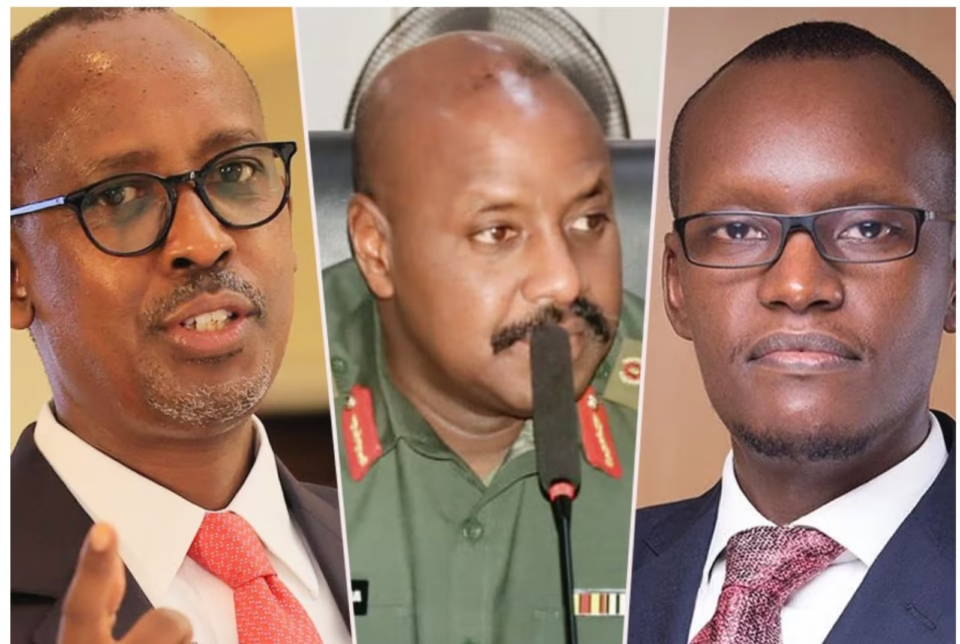
That is what has happened following an alleged exchange on X involving Gen. Muhoozi Kainerugaba and his brother-in-law, businessman and political figure Odrek Rwabwogo.
According to an account attributed to Muhoozi, another member of the First Family, Edwin Karugire, asked him to withdraw some of the threatening messages he had directed at Rwabwogo.
If the account is genuine, the incident raises questions about the relationships and competing interests within one of Uganda’s most politically influential families.
At first glance, it may look like a private family disagreement. But given the positions and public influence of those involved, it has inevitably attracted political attention.
The Museveni family is not an ordinary political family.
Over the years, members of the extended family have become prominent in politics, business, security and other areas of public life.
Gen. Muhoozi Kainerugaba serves as Chief of Defence Forces and has also become an increasingly prominent voice in Uganda’s political discussions.
Odrek Rwabwogo, who is married to President Museveni’s daughter Patience Rwabwogo, has built his own profile as a businessman and political figure.
Edwin Karugire, who is married to President Museveni’s daughter Natasha Museveni Karugire, is also part of the same extended family network.
Because of these connections, disagreements involving members of the family can easily become matters of public interest.
The issue is therefore not simply about who said what on social media. It is also about what such disagreements reveal about relationships within Uganda’s political establishment.
Muhoozi occupies an unusual position.
He is a senior military officer, a member of the President’s family and a public figure who frequently comments on political issues.
Over the years, his public statements have contributed to continued debate about Uganda’s political future and the question of succession.
That makes statements attributed to him particularly significant.
A disagreement between ordinary individuals might remain a private matter. But when one of the people involved is the country’s military commander, public attention is almost inevitable.
The key question, however, is whether the incident represents anything more than a personal disagreement.
At this stage, there is not enough publicly available information to conclude that it is evidence of a wider political conflict.
Odrek Rwabwogo has developed a political and business identity of his own.
His connection to the President through marriage gives him proximity to the centre of power, but that does not automatically mean that every disagreement involving him should be interpreted as a political struggle.
Still, influence in politics does not always come from an official government position.
It can come through relationships, access, business networks and the ability to participate in important conversations.
That is why any public disagreement between two prominent members of the extended presidential family is likely to generate speculation.
Is it simply a clash of personalities?
Could politics be involved?
Or is it nothing more than a family matter that happened to spill into public view?
For now, there is no clear evidence to settle those questions.
The reported involvement of Edwin Karugire adds another layer to the story.
According to the account attributed to Muhoozi, Karugire asked him to withdraw some of the messages directed at Rwabwogo.
If that account is accurate, it suggests that other members of the family were willing to intervene rather than allow the disagreement to continue publicly.
That naturally raises questions about how disagreements within the family are handled.
Who mediates when tensions rise?
Who has enough influence to ask another member to step back?
And how are sensitive disagreements resolved when those involved are connected to powerful political and security institutions?
Those questions cannot be answered simply by looking at social-media posts. They would require a much clearer understanding of the relationships involved.
The term “Deep State” is often used in Uganda to describe the networks of political, security, business and personal influence surrounding the country’s leadership.
Whatever terminology one chooses, there is a practical reality worth considering: people who operate close to the centre of power often have relationships that extend beyond formal government structures.
That is what makes this episode interesting.
It is not necessarily important because of the disagreement itself. Its significance comes from the fact that the people involved are part of a family with considerable political visibility.
Family relationships can influence political relationships.
Political relationships can affect access and influence.
And when those relationships involve senior state officials, the boundary between private disagreements and public affairs can become difficult to separate.
There is also a broader issue hanging over Uganda’s political debate: succession.
President Museveni has been in power for decades, and discussion about who will eventually succeed him has remained a sensitive subject.
Muhoozi’s name has frequently featured in those conversations.
For that reason, disagreements involving members of the President’s extended family are often viewed through the lens of succession, even when there is no direct evidence linking the dispute to the issue.
It would therefore be premature to describe the Muhoozi–Rwabwogo disagreement as proof of a succession struggle.
At the same time, it would be unrealistic to ignore the fact that succession remains an important part of how many Ugandans interpret political developments around the First Family.
Perhaps the most important issue is not who won an argument online.
It is what happens when people who are connected by family are also connected to different areas of political, military and economic influence.
Disagreements are normal in any family.
But when that family is closely connected to the centre of state power, even a personal dispute can attract political interpretation.
That is why observers are likely to continue watching the relationships between the different members of the extended presidential family.
For now, there is no basis for declaring that a major internal power struggle has broken out.
The disagreement could simply be resolved privately and disappear from public discussion.
But the incident has nevertheless highlighted the unusual intersection between family, politics, influence and succession in Uganda.
The reported Muhoozi–Rwabwogo dispute should not automatically be treated as evidence of a political war within the First Family.
Much of the information surrounding the episode comes from social media and requires independent verification.
What can be said is that the incident has once again drawn attention to the powerful network surrounding President Museveni and the way personal relationships can become politically significant when they involve people close to the centre of government.
The bigger question for Uganda is not who exchanged angry messages.
It is how the country’s political establishment will manage relationships, alliances and competing interests as the succession debate becomes increasingly important.
For now, the public may only be seeing a small part of what is happening behind the scenes.
And in Ugandan politics, sometimes the most important developments begin not with a major political announcement, but with a disagreement that unexpectedly becomes public.