
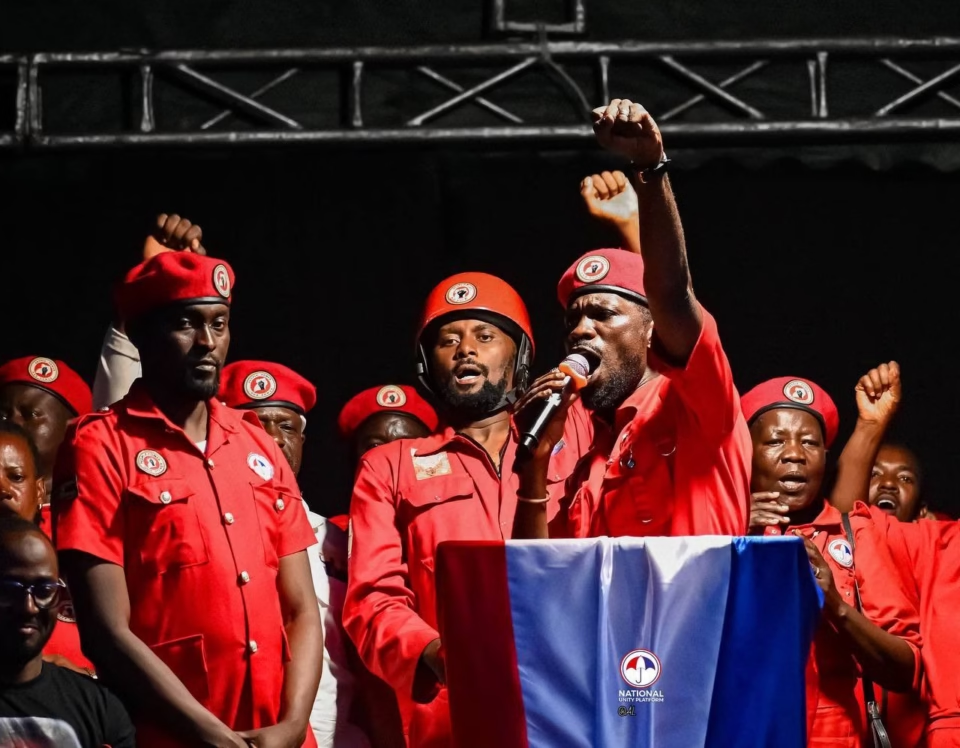
The National Unity Platform (NUP) has taken its fight over political party funding to the High Court in Kampala, accusing the government of deliberately sidelining the party in what it describes as a politically motivated and unlawful move.
In a petition filed before the Civil Division of the High Court, NUP is challenging a recent directive from Justice Minister Norbert Mao, which ordered the Electoral Commission (EC) to allocate public funds to only six political parties — leaving out NUP entirely.
The directive, issued on August 25, 2025, has sparked intense debate and drawn criticism from several quarters, with NUP insisting that the move violates both the Ugandan Constitution and the Political Parties and Organisations Act.
Despite being the second-largest political party in Parliament, NUP says it was excluded without warning, consultation, or a clear legal basis. In fact, party officials argue that the directive was issued before the necessary statutory instruments to implement recent amendments to the law were even in place — making any related action not just unfair, but also legally void.
“We’ve received funding every quarter since the 2021/2022 financial year,” said David Lewis Rubongoya, the NUP Secretary General, in an affidavit supporting the case. “This sudden change — without notice or consultation — isn’t just bad policy, it’s unlawful and targeted.”
Rubongoya added that NUP has been a committed participant in the National Consultative Forum (NCF) — even holding the position of Deputy Chairperson. Yet, the party claims it was deliberately excluded from discussions surrounding the implementation of the new Political Parties and Organisations (Amendment) Act, 2025.
That amendment, which came into force after presidential assent on June 15, 2025, introduces a new requirement: political party funding is now limited to parties that belong to and actively participate in the Inter-Party Organisation for Dialogue (IPOD).
NUP, which has long had a complicated relationship with IPOD, says this condition is both discriminatory and unconstitutional, and that it was never consulted before these changes were formalised.
“We’ve written letters. We’ve asked for official documents. We’ve even publicly requested to be included in consultations. Yet we’ve received nothing — not the statutory instrument, not the new IPOD framework, not even a reply,” Rubongoya said.
In the petition, NUP notes that it only discovered key decisions around party funding had been made during an IPOD summit held on September 18 — an event the party was neither informed of nor invited to attend. The summit, held at Kololo Independence Grounds, was attended by President Yoweri Kaguta Museveni, who handed over IPOD leadership to Minister Mao, as well as officials from parties like FDC, JEEMA, and UPC. NUP’s absence was conspicuous.
The party fears the financial blow could have serious consequences as Uganda gears up for the 2025/2026 general elections.
“This isn’t just a bureaucratic issue — this affects our ability to organise, to campaign, to function,” Rubongoya warned. “It threatens to cripple our operations and silence opposition voices.”
NUP is now asking the High Court for several remedies, including:
A declaration that the minister’s directive and EC’s actions are null and void;
A court order compelling the release of NUP’s share of public funding;
A permanent injunction to stop any future exclusions based on similar ground
In a response filed by EC litigation counsel Eric Sabiiti and lawyer Hamidu Lugolobi, the state has called for the case to be dismissed with costs. They argue the case is “incompetent, frivolous, and an abuse of court process,” claiming the High Court lacks the authority to intervene in such matters.
Sabiiti maintains that the new legal framework around political funding is lawful and that NUP’s expectations are misplaced. According to him, it’s not the court’s role to substitute policy choices made by the executive or Parliament.
The case is now before Justice Collins Acellam, who has scheduled it for mention on October 10, 2025. During the first appearance on Monday, the Attorney General requested two more days to file a formal response. NUP’s lawyers are expected to reply by Friday, after which the judge will assess whether all parties have complied with his instructions before setting a hearing date.
With the general elections looming and public interest in political fairness growing, the outcome of this case could set a significant precedent for how opposition parties are treated — not just in rhetoric, but in resources.