

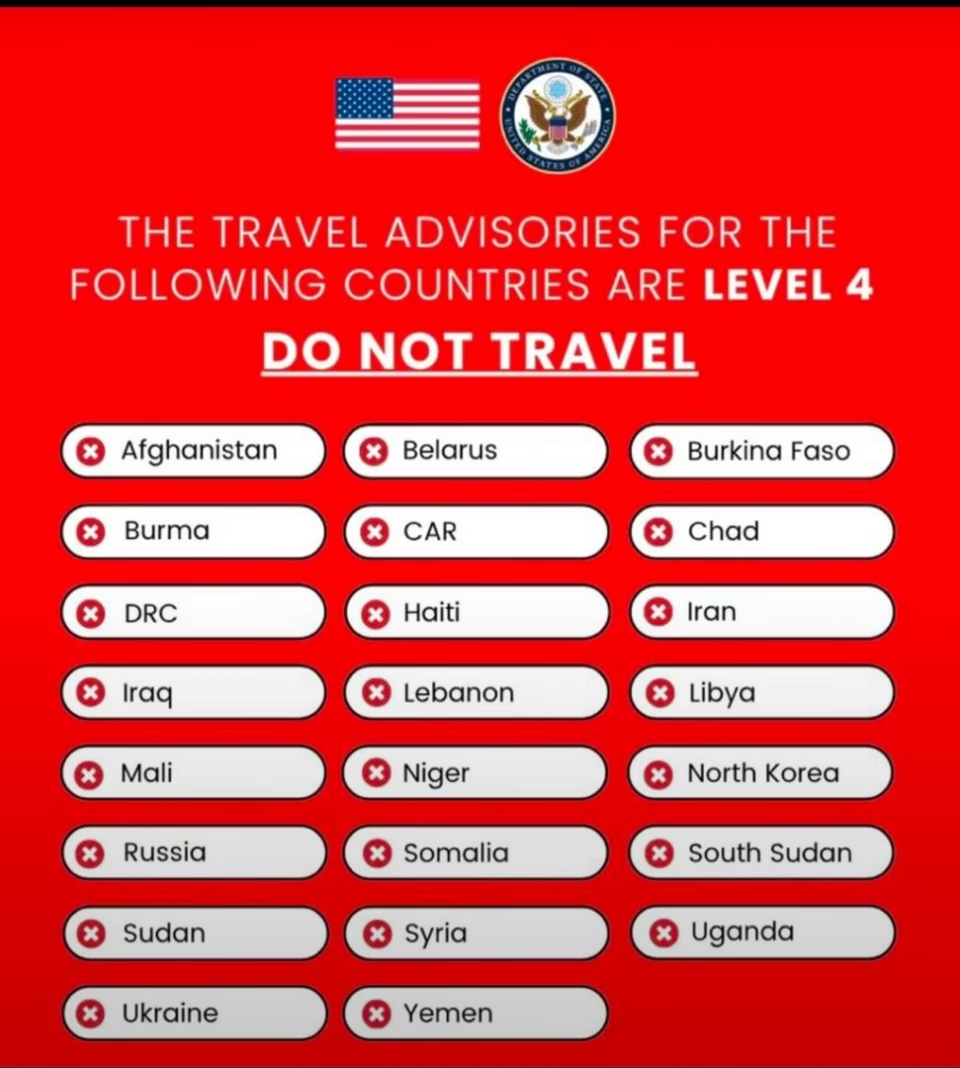
Uganda has been included among countries classified by the United States government under its highest travel advisory category, Level 4, meaning Americans are advised not to travel to the country, a development that could have far-reaching implications for Uganda’s tourism industry, international business, investment prospects and global reputation.
The warning was highlighted in a November 9, 2026 which explained that Level 4 advisories are issued for destinations considered dangerous because of prevailing local conditions or the limited ability of the US government to provide assistance to its citizens.
Uganda appears on the list alongside Afghanistan, Belarus, Burkina Faso, Burma, the Central African Republic, Chad, the Democratic Republic of Congo, Haiti, Iran, Iraq, Lebanon, Libya, Mali, Niger, North Korea, Russia, Somalia, South Sudan, Sudan, Syria, Ukraine and Yemen.
The classification is the highest of the four travel advisory levels issued by the US government.
According to the US State Department’s official Uganda travel advisory, the country was elevated from Level 3 to Level 4 on May 17, 2026, following concerns linked to the Ebola Bundibugyo outbreak, which was associated with cross-border transmission from the Democratic Republic of Congo.
The advisory was subsequently updated on June 4, 2026, without changing the risk classification. It identifies crime, health concerns, terrorism and civil unrest among the reasons for the warning.
However, Uganda’s Ministry of Health declared the Ebola outbreak over on July 28, 2026, raising questions about why the country continues to carry the highest travel warning even after the outbreak was brought under control.
The classification has also generated debate among Ugandan tourism stakeholders, who argue that maintaining the highest warning risks undermining efforts to market Uganda as a safe destination for international visitors.
One of the sectors likely to feel the effects of the advisory is tourism, which has increasingly become an important source of foreign exchange, employment and business opportunities.
Uganda recorded 1,642,215 international tourist arrivals in 2025, generating approximately Shs5.83 trillion in tourism earnings, according to figures released by the Ministry of Tourism, Wildlife and Antiquities.
The United States is also an important source market. Uganda received approximately 52,290 American visitors in 2025, making the country one of the notable overseas markets for Ugandan tourism.
A Level 4 warning could discourage American tourists, tour companies, travel agencies and international travel planners from including Uganda in their holiday packages.
The consequences could extend beyond tour operators to hotels, safari lodges, restaurants, transport companies, airlines, craft sellers, cultural performers and communities that depend on visitors.
Uganda’s major attractions, including Bwindi Impenetrable National Park, Queen Elizabeth National Park, Murchison Falls National Park, Kibale Forest and the source of the Nile, could face reduced bookings if international travellers begin associating the country with serious safety risks.
The gorilla-tracking industry could be particularly exposed because it depends heavily on advance bookings, international travel agents and visitors willing to spend substantial amounts on permits, accommodation and transport.
Although the advisory does not close Uganda’s national parks or prohibit foreigners from visiting, its psychological effect on prospective visitors could be significant.
The warning also raises questions about Uganda’s attractiveness as an investment destination.
International investors consider several factors before committing money to a country, including political stability, security, infrastructure, access to markets and the ability to protect employees and business operations.
A Level 4 travel advisory could introduce additional concerns among American companies considering business trips, investment missions, conferences and other commercial activities in Uganda.
Executives may become reluctant to send employees to Uganda, while companies could demand additional security arrangements, insurance coverage or alternative arrangements for conducting business.
This could affect sectors such as tourism, hospitality, energy, agriculture, manufacturing, financial services and technology.
It is important to note, however, that the advisory does not automatically prohibit American companies from investing in Uganda or conducting business with Ugandan institutions.
Rather, its significance lies in the additional risk perception it creates around doing business in the country.
Uganda also has commercial relations with the United States involving agricultural products, services and other economic activities.
According to the Office of the United States Trade Representative, total US-Uganda goods and services trade reached approximately US$1.1 billion in 2025.
A travel warning does not automatically impose trade restrictions or stop Ugandan exports from entering the American market.
Nevertheless, concerns about the country’s security environment could complicate business engagements, trade delegations, commercial negotiations and the movement of business executives.
American buyers and business partners could become more cautious about sending representatives to Uganda, potentially affecting opportunities for Ugandan businesses seeking international partnerships.
For exporters, the challenge would be ensuring that the travel advisory does not develop into broader negative perceptions that affect commercial confidence.
Beyond its immediate economic implications, the advisory presents a reputational challenge for Uganda.
Being grouped with countries such as Afghanistan, Iran, North Korea, Somalia, South Sudan and Sudan could create an unfavourable impression among international audiences unfamiliar with Uganda’s actual security and social conditions.
Although the countries listed have different political, security and economic circumstances, their appearance under the same advisory category could lead some international travellers to perceive them as facing comparable levels of danger.
This could undermine Uganda’s efforts to promote itself as the Pearl of Africa, particularly at a time when the government is investing in international tourism campaigns and promoting wildlife, cultural heritage and investment opportunities.
The situation also raises questions about how effectively Uganda communicates its security achievements, health improvements and tourism opportunities to international audiences.
The advisory could also influence travel decisions involving airlines, travel insurance companies and international tour operators.
Although it does not automatically prohibit flights into Entebbe International Airport, it could make some American travellers reconsider their journeys or choose destinations carrying lower risk classifications.
Some insurance providers may impose additional conditions, exclusions or higher premiums for travellers visiting destinations under the highest advisory category, depending on their individual policies.
This could make travel to Uganda more expensive or complicated for some visitors.
Airlines and travel companies could also experience changes in demand if American tourists and business travellers reduce their journeys.
However, the actual effect would depend on how travellers, insurance providers and commercial operators respond to the warning.
Uganda hosts international educational institutions, research programmes, religious organisations, humanitarian agencies and development partners.
American universities, researchers, volunteers and organisations that regularly send personnel to Uganda could review their travel arrangements in response to the advisory.
Some institutions may introduce stricter approval procedures, postpone field activities or require additional security assessments before sending staff and students into the country.
This could affect academic exchanges, medical research, community development programmes and humanitarian activities.
Organisations working in vulnerable communities could face additional logistical and administrative costs as they assess whether their personnel can continue operating under existing arrangements.
However, the advisory does not automatically terminate educational partnerships, scholarships or development programmes.
The classification could also become a diplomatic issue between Kampala and Washington.
Uganda and the United States have maintained relations involving security cooperation, trade, development assistance, public health and regional stability.
A travel advisory at the highest level could raise questions about Washington’s assessment of Uganda’s security environment and the country’s capacity to respond to threats affecting foreign nationals.
It could also create pressure on Ugandan diplomatic representatives to engage the US government over the specific concerns behind the classification.
For Kampala, the challenge will be demonstrating that the country has addressed the security and health concerns identified in the advisory while providing credible information about improvements on the ground.
The government may also need to strengthen communication with international partners to ensure that Uganda’s security situation is assessed using current and verifiable information.
Despite the strong wording, a Level 4 advisory is not a blanket travel ban against Uganda.
It is a recommendation issued by the US government advising American citizens not to travel to a particular destination because of serious risks.
It does not automatically prevent American citizens from entering Uganda, prohibit Ugandans from travelling to the United States, suspend commercial flights or impose economic sanctions against Uganda.
Uganda remains open to international visitors, subject to its existing immigration and entry requirements.
The distinction is important because the advisory is directed at American travellers and does not constitute an international prohibition on travel to Uganda.
The continued classification presents a challenge that requires more than public criticism of the American government’s decision.
The government needs to engage Washington diplomatically and seek clarification on the specific security and health concerns that continue to justify the Level 4 classification.
There is also a need for transparent communication on the state of public health, crime prevention, counterterrorism measures and the protection of visitors.
The Ministry of Tourism, Uganda Tourism Board, Ministry of Foreign Affairs and security agencies could work together to provide international travel operators with credible and regularly updated information.
Uganda also needs to strengthen its tourism marketing beyond traditional promotional campaigns by demonstrating improvements in destination security, emergency response and visitor protection.
Ultimately, the challenge is not simply to have the warning removed but to address the concerns that led to its issuance.
For a country seeking to expand tourism earnings, attract foreign investment and strengthen its international standing, remaining on the world’s highest travel warning category presents a serious reputational and economic challenge.
The question now is whether the government can convince the United States and the wider international community that Uganda is a safe and reliable destination for tourism, business and international engagement.