
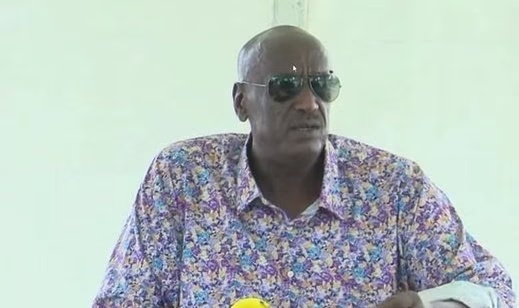
Speaking virtually from Gulu at the fifth edition of the Musevenomics Conference in Kampala, Gen Salim Saleh called for an urgent, well-resourced national study to uncover the true ownership of land in Kampala.
The former army commander and current coordinator of Operation Wealth Creation (OWC) emphasized that speculation, institutional opacity, and administrative distortions are undermining efforts to turn land into a productive economic resource.
“Everybody thinks I own half of Kampala, when in reality I own only about two acres — maximum,” Saleh told participants.
“The question of who owns land in Kampala is a very serious one. It must be investigated, studied, and documented with evidence.”
Saleh revealed he is collaborating with land governance expert Prof. John Kigula to fund and initiate a comprehensive land ownership study in the capital. Kigula has already drafted an advisory note, and fundraising is underway to operationalize the research.
Land ownership in Kampala has long been mired in confusion due to poor documentation, overlapping titles, informal tenures, and fragmented jurisdiction among entities such as the Uganda Land Commission, Kampala Capital City Authority (KCCA), Buganda Kingdom institutions, and private landlords.
According to the Ministry of Lands, only around 20% of Uganda’s land is formally registered, and even in Kampala, most titled plots are disputed or contain unclear histories.
A 2021 Global Land Tool Network (GLTN) survey found that over 60% of residents in Kampala’s informal settlements lack legal tenure, leaving them vulnerable to eviction and excluded from formal economic systems.
“If land is a distorted factor of production, then it distorts everything else — housing, infrastructure, industry, investment,” Saleh said.
“We can’t talk about stimulus or growth if we don’t know who owns the land where that growth must happen.”
Saleh criticized several government bodies — including the Uganda Land Commission, National Forestry Authority (NFA), and National Environment Management Authority (NEMA) — for mismanaging land under their stewardship.
“Sometimes it is these very agencies that create land conflicts,” he said.
“They are supposed to protect the land, but they don’t even know how to use it well.”
He highlighted that over 4 million acres of land in northern Uganda remain idle or under conservation, calling for a national dialogue to balance environmental protection with economic use.
Saleh also disclosed that the Internal Security Organisation (ISO) had recently questioned his land ownership in Kapeka, where the Namunkekera Industrial Estate — a flagship OWC project — is located.
“Thankfully, I had already documented everything — ownership, history, usage. But imagine being asked how you came to own land,” he said.
He proposed that Uganda produce a “land use balance sheet” — a national map of land ownership, usage, and productivity across freehold, leasehold, mailo, and customary tenures.
Land in Kampala is governed by a patchwork of laws, including the 1998 Land Act, the Registration of Titles Act, and historical Buganda Kingdom agreements dating back to colonial times. Much of central Kampala sits on mailo land, complicating leases and development.
Even public institutions — schools, markets, hospitals — often operate on untitled land, leading to frequent encroachments, legal battles, and project delays. KCCA has admitted difficulties in tracking and securing its own land assets.
Saleh urged that land reform be prioritized in Uganda’s next economic phase, just as security, liberalization, and privatization were in the past.
As the Musevenomics Conference continues this week with participation from Dr. Ezra Suruma, economists, policy experts, and OWC stakeholders, Saleh proposed moving future editions of the event to Gulu, citing its calmer environment.
“Let us produce a clear report out of this conference — and let that report include answers to the land question,” he concluded.
“That is the foundation for Uganda’s next phase of economic growth.”