


The Canadian government has extended temporary immigration and border measures affecting residents of Uganda, the Democratic Republic of Congo (DRC) and South Sudan as it responds to the ongoing Ebola outbreak in the region.
The measures, announced by Immigration, Refugees and Citizenship Canada (IRCC), have been extended for another 60 days and will remain in effect until November 27, 2026.
Under the immigration measures, foreign nationals whose last country of residence was Uganda, South Sudan or the DRC may be unable to travel to Canada during the suspension period, even if they already hold an approved temporary resident visa, permanent resident visa or electronic travel authorisation (eTA).
IRCC said it will continue processing new and existing applications from people affected by the measures, but applications will not be finalised while the restrictions remain in force.
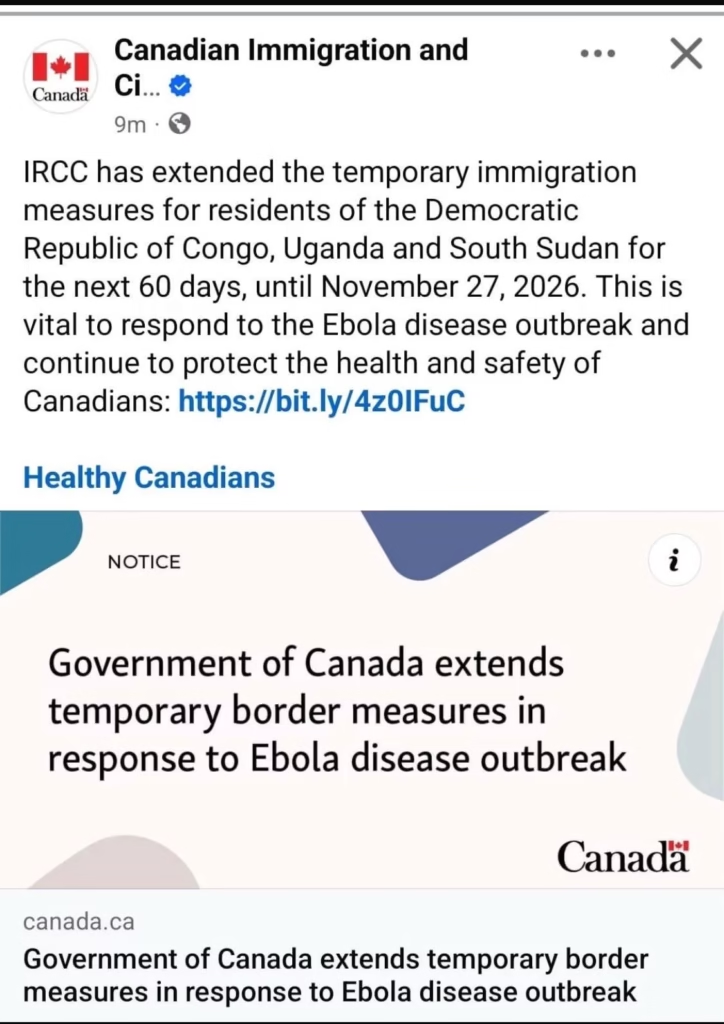
The measures are linked to concerns over the Ebola outbreak in the DRC and the risk of the disease spreading to neighbouring countries, including Uganda and South Sudan.
Canada has also introduced health-related border measures for people who have recently travelled through the affected countries.
Travellers who have been in Uganda, South Sudan or the DRC within the previous 21 days are subject to health assessment requirements. Foreign nationals who have been in Uganda or South Sudan during that period can generally travel to Canada but must undergo a 21-day quarantine, unless they qualify for an exemption.
Foreign nationals who have been in the DRC within the previous 21 days are prohibited from entering Canada, with certain exemptions.
Canadian citizens, permanent residents and people registered under the Indian Act who have travelled through the affected countries can still enter Canada, but may be required to undergo health screening and quarantine.
The Canadian government says the measures are precautionary. Canada previously stated that the health risk to people in the country remained low, while stressing the severity of Ebola disease and the need to reduce the possibility of the virus being imported.
For Ugandans with Canadian immigration applications, the extension means that those affected by the temporary measures may face continued delays in travelling to Canada or having their applications finalised.
The restrictions are based largely on the last country of residence listed on an immigration application rather than citizenship. Therefore, a Ugandan citizen who was living outside Uganda when they applied may not necessarily be affected by the measures.
IRCC also allows people affected by the restrictions to request exemptions in certain circumstances. Requests are considered individually, taking into account factors including humanitarian considerations and the public-health risk involved.
The latest extension means the temporary measures will now remain in place through November 27, 2026, unless the Canadian government changes or ends them earlier.