

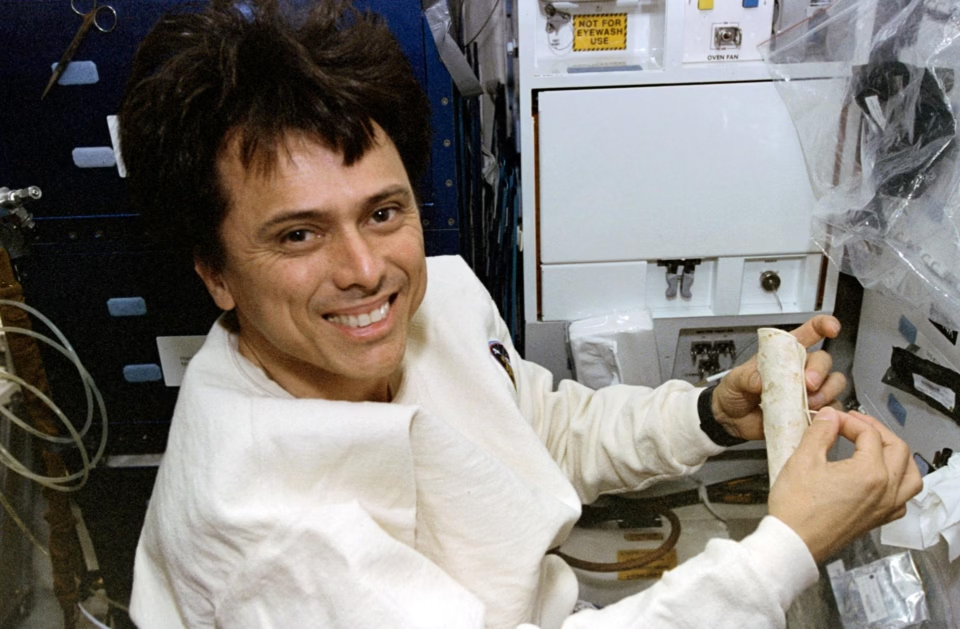
On January 12,1986, astronaut and physicist Franklin Chang-Diaz becomes the first Hispanic American to fly in space on the Space Shuttle Columbia, which orbited Earth 96 times, deployed the SATCOM KU satellite used for broadcast television and conducted experiments in astrophysics. It was a high point in an aeronautical career with plenty of high points.
That six-day flight was the first of his seven space missions, tying the record for most space flights held by astronaut Jerry Ross. He participated in three space walks on his last mission on the Space Shuttle Endeavour launched on June 5, 2002, to resupply the International Space Station and exchange its crew.
Chang-Diaz’s milestone as the first Hispanic American immigrant to fly in space follows that of two Latin Americans to do so: Arnaldo Tamayo Mendez of Cuba who spent eight days on the Soviet Union’s Salyut-6 space station in September 1980, and Mexico’s Rodolfo Neri Vela on the Space Shuttle Atlantis launched in November 1985, just two months before Chang-Diaz’s first flight.
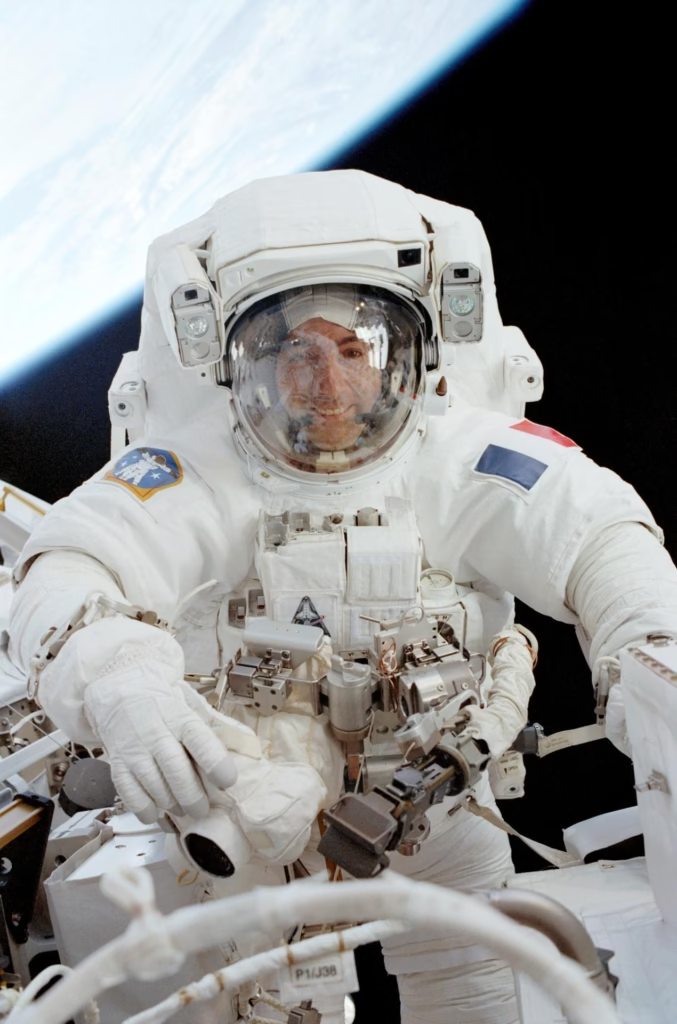
Son of an oil worker whose own father escaped China during the Boxer Rebellion at the turn of the 20th century, Chang-Diaz sat outside the U.S. Embassy in Costa Rica as a child listening to radio broadcasts from NASA’s mission control in Houston, dreaming of becoming an astronaut. He immigrated to the United States in 1968, when he was about 18, and studied mechanical engineering at the University of Connecticut.
In 1977, he received a Ph.D. in applied plasma physics at the Massachusetts Institute of Technology, where he did intensive research in the United States’ controlled fusion program on designing and operating fusion reactors. He became a U.S. citizen that year. He later led a plasma propulsion program at MIT to develop technology for future human missions to Mars. After retiring from NASA in 2005, he became a space entrepreneur. He founded the Ad Astra Rocket Company, which develops sustainable and efficient high-power engines and plasma propulsion systems that combine with electricity to stay longer and go further into space. The goal is to make human and robotic space travel practical and economical so humans can explore and settle anywhere in the solar system.