
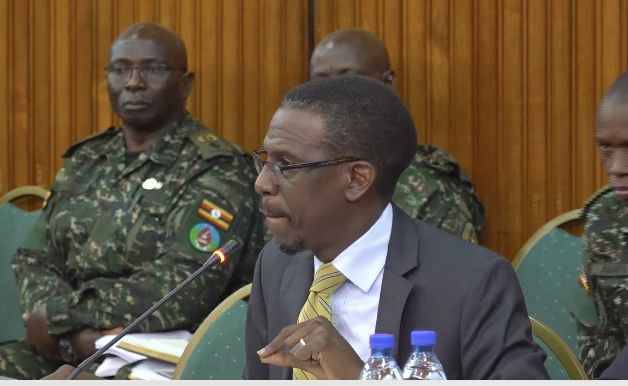
Attorney General Kiryowa Kiwanuka has clarified that the Supreme Court’s January 2025 ruling did not ban the trial of civilians in military courts, but instead raised constitutional concerns about the composition of the General Court Martial.
Appearing before Parliament’s Joint Committee on Legal and Defence Affairs, Kiwanuka emphasized that the ruling questioned the structure of the Army Court rather than its jurisdiction over civilians.
“The Supreme Court did not say civilians cannot be tried in the General Court Martial,” Kiwanuka stated. “The issue was whether the Court Martial, as currently constituted, aligns with the Constitution.”
The Attorney General made his remarks during deliberations on the UPDF Amendment Bill, 2025, introduced by Defence Minister Jacob Oboth.
The Bill seeks to:
- Restructure the Courts Martial system
- Define its jurisdiction
- Specify qualifications for chairpersons
- Establish a Military Courts Department
The proposed amendments outline exceptional circumstances under which civilians may face military court proceedings, including:
- Unlawful possession of arms, ammunition, or military equipment
- Aiding soldiers in serious crimes like murder, treason, or kidnap
- Unauthorized use of military uniforms or gear
Opposition MP Mathias Mpuuga (Nyendo-Mukungwe) questioned whether the Bill infringes on constitutional protections under Articles 28 and 44(c), arguing that civilian courts should try civilians—even in cases involving military-related offenses.
Abdu Katuntu (Bugweri County) supported military trials in cases involving heavy weaponry, but criticized the politicization of military justice:
“If a civilian is caught with artillery, try them in military court—but not over a beret,” Katuntu said.
Jimbricky Norman Ochero (Labwor County) supported the Bill, citing the urgent need to deter illegal arms proliferation. However, Naboth Namanya (Rubabo County) raised concerns about ambiguous definitions in the Bill—such as black shoes being classified as military attire.
Attorney General Kiwanuka reiterated that the amendments are intended to streamline security operations and clarify jurisdiction—not to arbitrarily target civilians.
“This is about clarity in law enforcement—not undermining civilian rights,” he said.