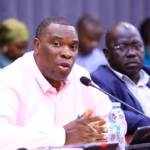


Uganda’s business community is increasingly turning against the Uganda Revenue Authority (URA), with downtown Kampala traders demanding the resignation of Commissioner General John Musinguzi Rujoki over what they describe as punitive tax enforcement, unequal treatment and an increasingly difficult business environment.
The latest confrontation unfolded after a planned engagement between URA leadership and traders at the authority’s headquarters in Nakawa, Kampala, collapsed before meaningful discussions could take place. As the disagreement continues to attract attention, no official statement has yet been issued by URA’s top leadership addressing the confrontation, the traders’ demonstrations or the growing calls for Musinguzi’s resignation.
The meeting had been organised to give businesspeople an opportunity to raise concerns about taxation policies, the Electronic Fiscal Receipting and Invoicing Solution (EFRIS), customs valuation, under-declaration of imported goods, the rising dollar and the increasing cost of doing business.
However, the engagement took an unexpected turn after URA reportedly received intelligence suggesting that some individuals intended to disrupt the meeting and heckle Musinguzi.
Security personnel consequently introduced restrictions requiring participants to surrender their mobile phones before entering the meeting venue. While some traders complied, others rejected the arrangement, questioning why they were being denied access to their personal devices during an engagement intended to address their business concerns.
The disagreement escalated, prompting several traders to walk out, while others later protested within the URA premises.
The confrontation subsequently spilled into downtown Kampala, where traders in arcades, including Nabugabo and Park View, staged demonstrations and sit-down protests, demanding Musinguzi’s immediate resignation.
At the centre of their grievances is growing dissatisfaction with URA’s tax administration, which traders accuse of imposing unbearable financial pressure on locally owned businesses.
Some demonstrators have argued that aggressive tax enforcement, high tax assessments and EFRIS requirements are making it increasingly difficult for small and medium-sized enterprises to remain operational.
Others have raised allegations of unequal treatment, claiming that foreign-owned businesses, particularly Chinese traders, enjoy tax exemptions or preferential treatment while Ugandan entrepreneurs face strict enforcement. These allegations require clarification from URA and relevant government institutions.
The protests raise a broader question about whether Uganda’s tax administration is striking the right balance between revenue collection and protecting the businesses that sustain employment, investment and economic activity.
Assistant Commissioner for Public and Corporate Affairs Robert Kalumba expressed disappointment over the failed engagement, arguing that the authority had organised the meeting in good faith to listen to traders and find solutions to their concerns.
He maintained that the mobile phone restriction was part of security arrangements intended to maintain order and prevent distractions.
Kalumba also indicated that URA would organise another meeting, insisting that traders remain important stakeholders in the country’s revenue administration.
However, the unfolding disagreement suggests that the problem extends beyond the failed meeting arrangements. Traders appear increasingly dissatisfied with the broader relationship between the tax authority and the business community.
The question of responsibility also remains important. While traders are directing much of their anger towards Musinguzi, tax rates and the broader tax framework are established through legislation by Parliament. URA’s responsibility is primarily to administer and enforce those laws.
This raises questions about whether the demands for Musinguzi’s resignation are directed at the appropriate level of government, or whether Parliament and the Ministry of Finance should also face scrutiny over the tax policies and economic conditions fuelling the discontent.
The controversy is unfolding against another difficult development for Kampala’s business community: the government’s response to the deadly October 30 and 31, 2025 floods, which exposed serious weaknesses in urban planning, building management and drainage infrastructure.
Following investigations into the flooding, Cabinet directed the immediate eviction of traders and other occupants operating in basement spaces originally approved for vehicle parking.
ICT Minister Justine Kasule Lumumba announced that investigations had identified buildings where parking basements had allegedly been converted into shops and business premises, exposing occupants to serious danger during flooding.
Other identified problems included buildings and developments obstructing drainage corridors, blocked drainage outlets, failure to desilt channels and illegal constructions interfering with the movement of stormwater.
Cabinet subsequently tasked the Office of the Prime Minister, Kampala Capital City Authority (KCCA), the Ministry of Works and Transport, and the Ministry of Water and Environment to prepare a coordinated intervention plan within one month.
The government also approved Shs18.9995 billion in compassionate ex-gratia assistance for 1,841 verified traders who suffered losses during the October 2025 floods, particularly in 13 arcades and Central Kikubo Market.
Although the assistance is intended to provide relief to affected businesses, the planned eviction of traders from illegally converted basement premises presents another challenge for businesspeople already struggling with taxation, operating costs and declining business conditions.
The developments expose a difficult situation facing Kampala’s commercial sector: traders are demanding a more accommodating tax administration while government is simultaneously enforcing building and drainage regulations that could force some businesses out of their current premises.
Meanwhile, the recent resignation of URA Board Chairman Emmanuel Katongole after approximately six months in office adds another dimension to questions surrounding leadership and institutional stability at the revenue authority.
Ultimately, the confrontation presents government with a bigger challenge than the resignation demands directed at one commissioner general.
Can Uganda sustain aggressive revenue collection, enforce urban regulations and protect public safety without undermining the survival of local businesses?
As traders demand accountability from URA, the government must address the underlying grievances, clarify allegations of unequal tax treatment and establish whether existing tax policies are supporting or suffocating the businesses expected to drive Uganda’s economic growth.
The planned URA-traders meeting may be rescheduled, but restoring confidence between the tax authority and the business community will require more than another meeting. It will require credible answers, transparency and practical reforms.