

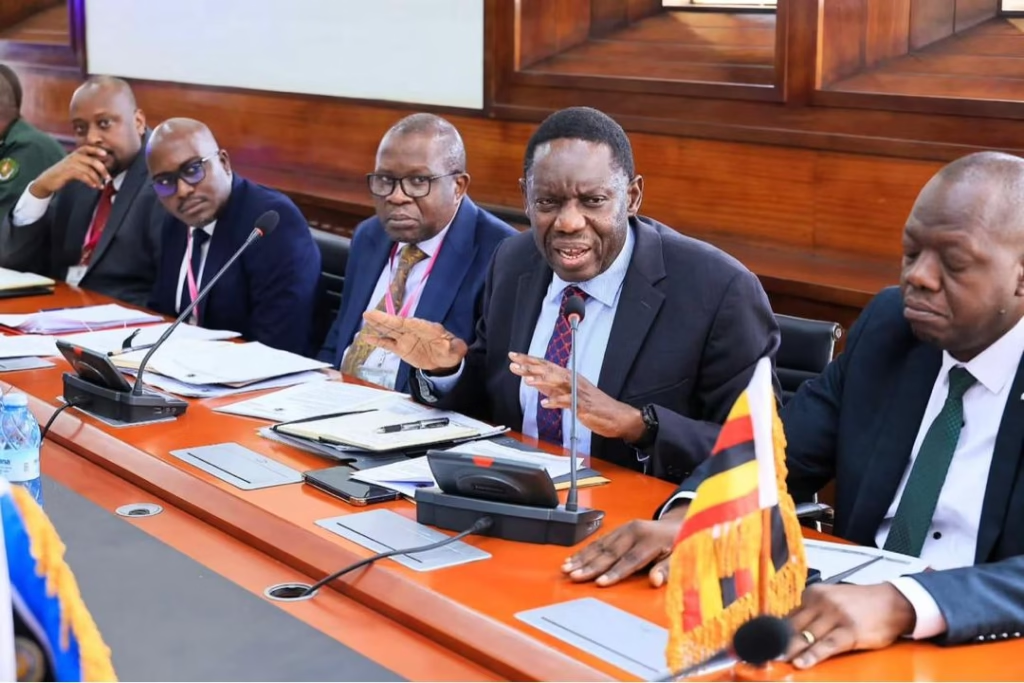
Speaker of Parliament Rt. Hon. Jacob Markson Oboth has brokered a compromise between the Bank of Uganda (BoU) and the Uganda Co-operative Savings and Credit Union Limited (UCSCU) over the licensing and regulation of large Savings and Credit Cooperative Organisations (SACCOs).
The agreement was reached after a two-hour meeting at Parliament convened by Speaker Oboth following a petition by UCSCU over what the SACCO umbrella body described as unreasonable regulatory requirements imposed by the central bank.
Under the agreement, the licensing deadline for large SACCOs has been extended from September 30, 2026, to March 2027, giving SACCOs additional time to comply while consultations on the regulatory framework continue.
Speaker Oboth said the parties had agreed on a phased approach to compliance, intended to allow SACCOs to meet regulatory requirements without disrupting their operations.
He also urged the Ministry of Finance, Planning and Economic Development to initiate amendments to the law governing SACCOs to address what stakeholders have described as overlapping regulatory mandates.
The disagreement centres on the transition of large SACCOs into the Bank of Uganda’s licensing and supervisory framework.
The framework targets SACCOs whose voluntary savings exceed Shs1.5 billion and institutional capital is at least Shs500 million. More than 90 SACCOs have been identified as falling within the category.
BoU has argued that stronger supervision is necessary as SACCOs grow and handle increasingly large amounts of members’ savings. The central bank’s position has been linked to concerns around financial stability, governance, risk management and protection of members’ funds.
However, UCSCU and other cooperative-sector stakeholders have questioned aspects of the licensing requirements and raised concerns about the interaction between the different laws governing SACCOs.
The regulatory environment currently involves the Ministry of Trade, Industry and Cooperatives, the Ministry of Finance and Bank of Uganda, with different pieces of legislation applying to different aspects of SACCO operations.
The latest agreement comes just days after BoU had maintained that the September 30 deadline would not be extended.
On September 21, the central bank was reported to have maintained that eligible SACCOs had to submit their applications by September 30, with regulated financial service providers expected to transact only with licensed large SACCOs thereafter.
At the time, only a small proportion of the eligible SACCOs had completed the licensing process. Daily Monitor reported on September 7 that seven of about 90 large SACCOs had obtained licences, while 15 applications were still being processed.
The extension to March 2027 therefore changes the immediate regulatory timeline and gives the parties more time to resolve the outstanding legal and operational questions.
The dispute highlights a broader question about how Uganda should regulate SACCOs as they become increasingly important financial institutions.
On one side, stronger regulation can provide greater oversight of institutions holding members’ savings. On the other, SACCOs have argued that applying requirements designed for larger financial institutions without adequately accounting for their cooperative structure could create operational difficulties.
The figures surrounding the licensing process also show why the issue has become significant. With dozens of eligible SACCOs still outside the BoU licensing framework shortly before the original deadline, strict enforcement could have created uncertainty for institutions serving large numbers of members.
The agreement also does not appear to settle the underlying legal question permanently. Instead, it creates more time for consultations and possible legislative changes.
The key issue going forward will therefore be whether the additional period produces a clear and harmonised regulatory framework, rather than simply another extension of the existing dispute.
For SACCO members, the practical concern remains the protection of their savings and continued access to financial services. For regulators and government, the challenge is to establish a system that provides effective supervision while clearly defining which institution is responsible for each aspect of SACCO operations.