
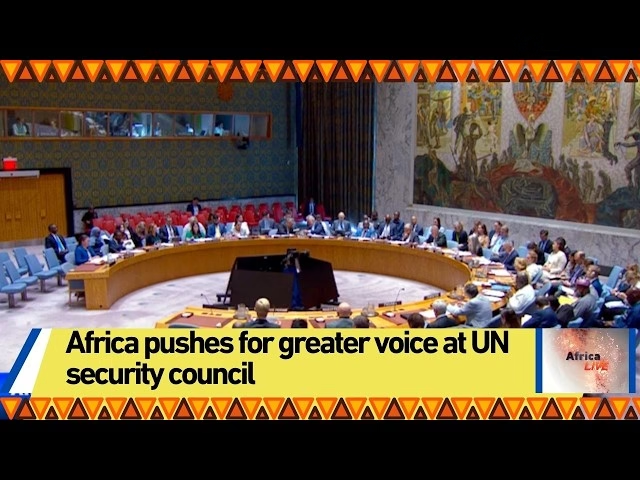
A renewed debate over Africa’s representation on the United Nations Security Council has put the continent’s long-running demand for permanent membership back in the spotlight.
The debate has been amplified by social media commentary questioning why Africa, despite having 55 UN member states and playing a major role in international peace and security discussions, does not have a permanent seat on the Council.
The UN Security Council has 15 members, including five permanent members — China, France, Russia, the United Kingdom and the United States — all of which have veto power. The remaining 10 members are elected by the General Assembly for two-year terms.
Africa currently has non-permanent representation on the Council. The Democratic Republic of Congo, Liberia and Somalia are among the elected members serving in 2026. However, no African country holds a permanent seat.
The African Union’s position is based on the Ezulwini Consensus and the Sirte Declaration, adopted as the continent’s common position on Security Council reform.
Under the African position, the continent is seeking at least two permanent seats with all the privileges of permanent membership, including the veto if the veto continues to exist, as well as five non-permanent seats. The AU also wants the right to determine which African countries occupy the seats on behalf of the continent.
The AU has continued to argue that the current structure does not adequately reflect the world’s contemporary political and demographic realities. In May 2026, AU Commission Chairperson Mahmoud Ali Youssouf described Africa’s exclusion from permanent representation as a historical injustice and called for stronger international support for the African position.
Supporters of the reform argue that permanent African representation would give the continent a stronger role in decisions concerning international peace and security, including conflicts and peacekeeping operations affecting African countries.
The AU’s position also links Security Council reform to broader questions of Africa’s representation in global decision-making institutions. In its 2026 submission to the UN reform negotiations, the African Group called for an expanded Council that would better reflect today’s international system.
The issue is particularly significant because many matters involving African conflicts, sanctions and peacekeeping come before the Security Council, even though no African state currently participates in its permanent decision-making structure.
The renewed discussion has also raised a broader question: whether Africa should continue concentrating its efforts on gaining a place within existing global institutions or seek stronger continental institutions and mechanisms of its own.
However, the African Union’s official position remains focused on reforming the existing UN Security Council, rather than creating a separate alternative. The AU has maintained that African countries should remain united behind the Common African Position while mobilising support from other UN member states.
The question of Security Council reform has remained under intergovernmental negotiations for years, with disagreements among UN member states over the size of an expanded Council, permanent membership, the veto and regional representation.
For Africa, the central issue is therefore not simply whether the continent should have a seat at the table, but how much decision-making authority that representation would carry and who would exercise it on behalf of the continent.