

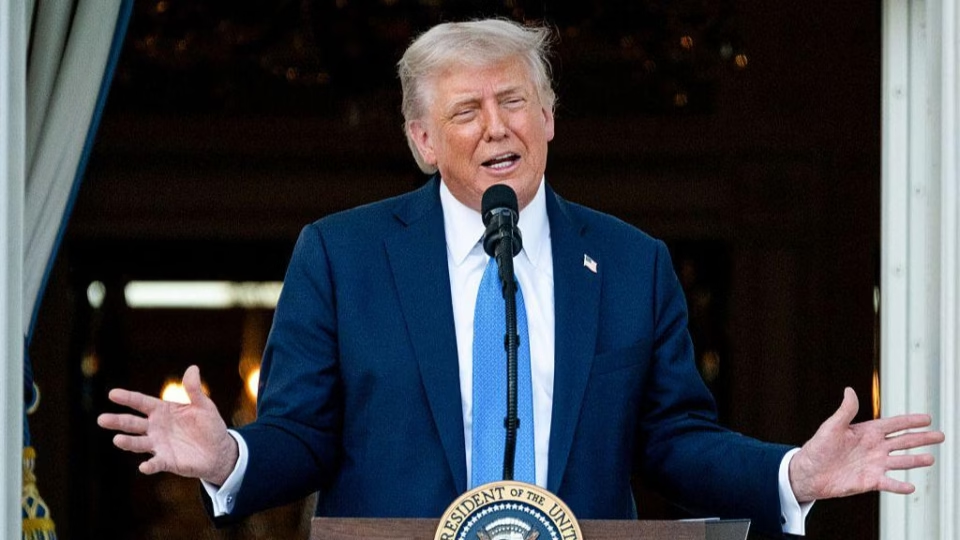
Former President Donald Trump has announced a sweeping new travel ban targeting citizens from nearly 20 countries, citing national security concerns. The order, which he signed on Wednesday night, has sparked global criticism and reignited a fierce immigration debate in the U.S.
According to Trump, the move is intended to prevent entry of foreign nationals who are “not properly vetted” or who overstay their visas. He pointed to a recent attack in Boulder, Colorado, involving an Egyptian national, as justification. Yet Egypt is notably absent from the banned list—raising questions about the motivations behind the selections.
Congressman Clay Higgins of Louisiana defended the order on BBC Radio 4, stating, “Travelling to the U.S. is a privilege, not a right.” He argued that the American public has “had enough of immigrants coming to our country, violating our laws and committing violence.” Higgins, a Republican on the House Homeland Security Committee, claimed that some immigrants legally admitted had gone on to commit terrorist acts.
Starting June 9, the ban will fully restrict travel to the U.S. from 12 countries:
- Afghanistan, Myanmar, Chad, Republic of the Congo, Equatorial Guinea, Eritrea, Haiti, Iran, Libya, Somalia, Sudan, and Yemen.
Another seven countries face partial restrictions:
- Burundi, Cuba, Laos, Sierra Leone, Togo, Turkmenistan, and Venezuela.
- Athletes competing in global sporting events, such as the World Cup and Olympics.
- Holders of immigrant visas from persecuted minorities.
- Dual nationals and lawful permanent residents.
Despite its scope, the proclamation provides leeway for the Secretary of State to grant individual exemptions on a case-by-case basis
Trump claims the affected countries either have high visa overstay rates, political instability, or lack reliable identity verification systems. However, only one—Iran—is officially listed as a state sponsor of terrorism. Critics argue this weakens the administration’s security rationale.
Some countries, such as Myanmar, are already war-torn and lack functioning central governments. Observers note that these are the same nations whose citizens are most likely to be refugees and asylum seekers—raising humanitarian concerns
Human Rights First called the ban “truly punitive” and an attempt to sow chaos in the immigration system. Amnesty International USA described it as “racist, discriminatory, and downright cruel.” Many rights groups highlight that most of the targeted countries are in crisis, with citizens fleeing conflict, persecution, and repression.
Harvard University condemned Trump’s accompanying order to suspend new foreign student visas, calling it “retaliatory” and unconstitutional. The White House accused Harvard of lax oversight and alleged foreign ties, particularly with China.
Venezuela condemned the move as supremacist and fascist. Somalia expressed willingness to work with the U.S. to improve security cooperation.
Meanwhile, public response has been polarized. In cities like New York and Los Angeles, protests are already underway, echoing demonstrations that followed Trump’s 2017 travel ban.
Analysts describe this as a more calculated version of Trump’s earlier 2017 ban, which was revised and eventually upheld by the Supreme Court. This new order expands beyond Muslim-majority countries and doesn’t have a set expiration date—suggesting it’s built to survive longer and withstand legal challenges.
North America correspondent Jake Kwon notes that while the countries differ, the message is the same: Trump is delivering on campaign promises. “It’s no coincidence that the ban comes just months before the 2025 election,” he writes. “This is red meat for Trump’s base.”
Trump’s new travel ban has reignited deep divisions over immigration, national security, and America’s role as a haven for the world’s vulnerable. While the administration insists the policy is about vetting and protection, critics say it’s driven more by politics than actual threats. With legal battles looming and protests mounting, the true impact of the ban—on lives, law, and international relations—remains to be seen